
Assessment of indoor chemical pollutant emissions from scented candle burning
DOI:
https://doi.org/10.55225/sti.754Keywords:
scented candles, indoor air quality, formaldehyde, volatile organic compounds, carbon dioxideAbstract
Background: Scented candles are widely used indoors for decorative and aromatherapeutic purposes, but combustion may contribute to the accumulation of gaseous pollutants and deterioration of indoor air quality.
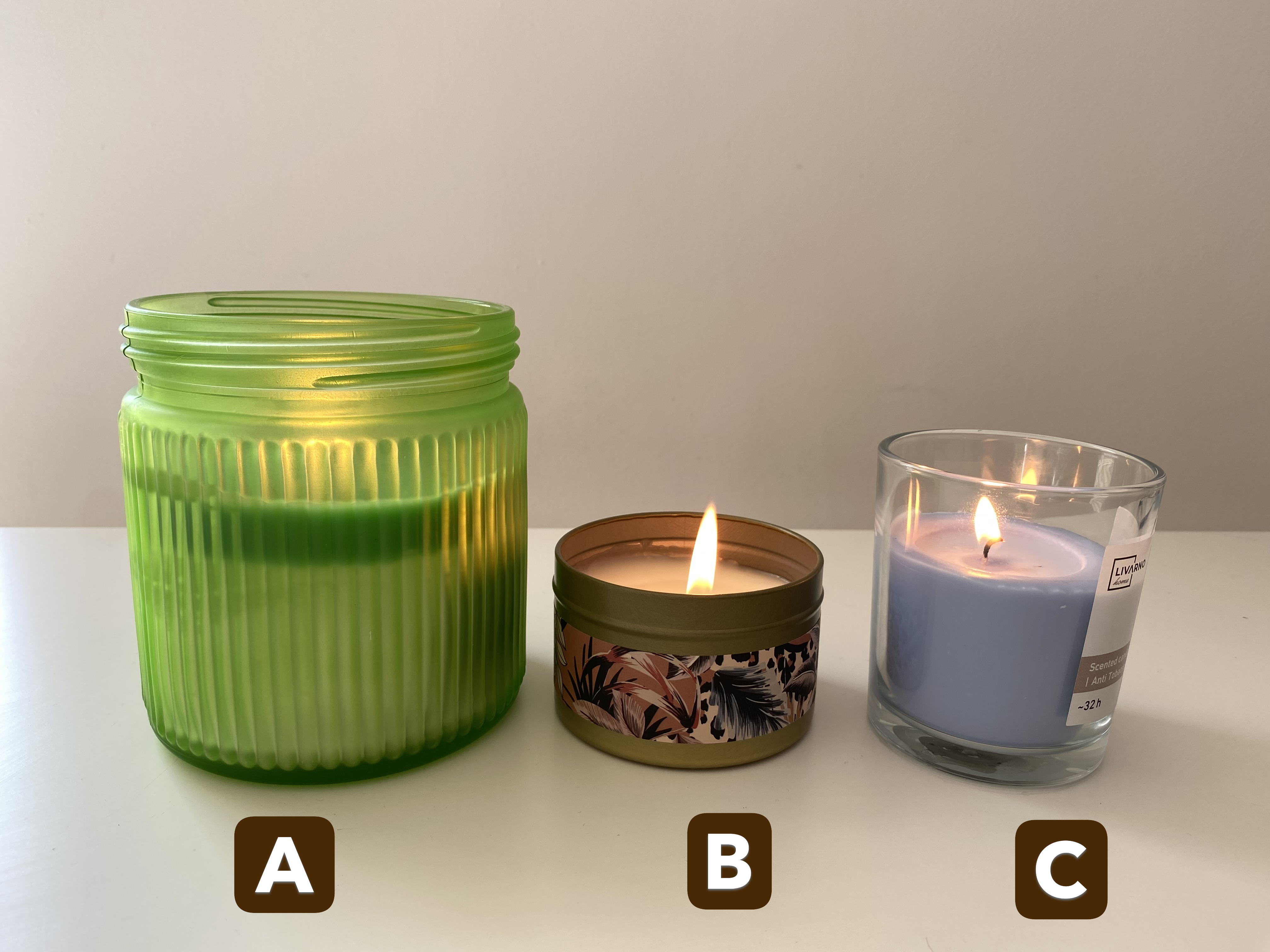
Objective: To assess temporal changes in formaldehyde, total volatile organic compounds, carbon dioxide, carbon monoxide, and benzene during the combustion of three commercially available scented candles.
Materials and methods: Three different scented candle products were tested individually in a residential room with a floor area of 11 m² and an approximate volume of 25 m³. Each candle was burned for 60 minuts in a closed room. Pollutant concentrations were monitored using a low-cost ZN-MT32 multi-parameter air-quality sensor at 0, 5, 10, 15, 30, 45, and 60 minuts. One experimental run was performed for each candle.
Results: Carbon dioxide increased for all candles. The increases after 60 minuts were 414 mg/m³ for candle A, 493 mg/m³ for candle B, and 326 mg/m³ for candle C. Formaldehyde showed the maximum concentration for candle C, reaching 132 µg/m³, while maximum concentrations for candles B and A were 55 and 24 µg/m³, respectively. Maximum total volatile organic compounds concentrations were 332, 139, and 64 µg/m³ for candles C, B, and A, respectively. No measurable changes in carbon oxide or benzene were observed under the experimental conditions.
Conclusions: The tested candles produced different temporal pollutant profiles. Candle C showed the highest formaldehyde and total volatile organic compounds concentrations, whereas candle B produced the largest increase in indoor carbon dioxide. The findings support the need for adequate ventilation during prolonged candle use. Because the study used a low-cost sensor and a single experimental run per product, the results should be regarded as indicative rather than as reference-grade emission measurements.
Downloads
References
United States Environmental Protection Agency. Candles and incense as potential sources of indoor air pollution: Market analysis and literature review. Washington (DC): EP; 2001. [Internet] [cited 2026 Aug 7]. Available from: https://nepis.epa.gov/Exe/ZyPURL.cgi?Dockey=P1009BZL.TXT. Google Scholar
Derudi M, Gelosa S, Sliepcevich A, Cattaneo A, Rota R, Cavallo D, Nano G. Emissions of air pollutants from scented candles burning in a test chamber. Atmospheric Environment. 2012;55:257–262. https://doi.org/10.1016/j.atmosenv.2012.03.027. DOI: https://doi.org/10.1016/j.atmosenv.2012.03.027 Google Scholar
Salthammer T, Gu J, Wientzek S, Harrington R, Thomann S. Measurement and evaluation of gaseous and particulate emissions from burning scented and unscented candles. Environment International. 2021;155:106590. https://doi.org/ 10.1016/j.envint.2021.106590. DOI: https://doi.org/10.1016/j.envint.2021.106590 Google Scholar
Yun H, Seo JH, Kim YG, Yang J. Impact of scented candle use on indoor air quality and airborne microbiome. Scientific Reports. 2025;15:10181. https://doi.org/10.1038/s41598-025-95010-0. DOI: https://doi.org/10.1038/s41598-025-95010-0 Google Scholar
Guo Z, Mosley R, McBrian J, Fortmann R. Fine particulate matter emissions from candles. Washington (DC): U.S. Environmental Protection Agency; 2001. Google Scholar
ZN MT-32. Manual and technical specification. [Internet] [cited 2026 Aug 7]. Available from: https://manuals.plus/ae/1005010076127553. Google Scholar
Buček P, Maršolek P, Bílek J. Low-cost sensors for air quality monitoring: the current state of the technology and a use overview. Chemistry, Didactics, Ecology, Metrology. 2021;26(1–2):41–54. https://doi.org/10.2478/cdem-2021-0003. DOI: https://doi.org/10.2478/cdem-2021-0003 Google Scholar
Hayward I, Martin NA, Ferracci V, Kazemimanesh M, Kumar P. Low-Cost air quality sensors: Biases, corrections and challenges in their comparability. Atmosphere. 2024; 15(12):1523. https://doi.org/10.3390/atmos15121523. DOI: https://doi.org/10.3390/atmos15121523 Google Scholar
Chattopadhyay A, Huertas A, Rebeiro-Hargrave A, Fung PL, Varjonen S, Hieta T, Tarkoma S, Petäjä T. Low-cost formaldehyde sensor evaluation and calibration in a controlled environment. IEEE Sensors Journal. 2022;22(12):11791–11803. https://doi.org/10.1109/JSEN.2022.3163892. DOI: https://doi.org/10.1109/JSEN.2022.3172864 Google Scholar
Downloads
Published
How to Cite
Issue
Section
License
Copyright (c) 2026 Marek Chyc, Natalia Chyc

This work is licensed under a Creative Commons Attribution-ShareAlike 4.0 International License.