
Evaluation of the effectiveness of three disinfectants used for chicken hatching egg disinfection based on microbiological analyses and hatchability results
DOI:
https://doi.org/10.55225/sti.757Keywords:
biosecurity, eggs contamination, mortality, one day chick, hatcheryAbstract
Objective: The aim of the study was to compare three commercial disinfection procedures for chicken hatching eggs with respect to eggshell microbial contamination, embryonic mortality, macroscopic signs of egg-content contamination, and hatchability.
Materials and methods: A single commercial batch of 2,250 hatching eggs from 59-week-old Ross 308 broiler breeders was divided into three groups of 750 eggs. Eggs were disinfected with 1% Virocid®, 1% Virkon S®, or Fumagri HA® applied by fumigation at 0.8 g/m³. Due to the study being conducted under commercial hatchery conditions, where all hatching eggs undergo routine disinfection, it was not possible to establish an untreated control group comprising eggs that had not been subjected to disinfection. Microbiological samples were collected before disinfection and 15 min after treatment. Incubation outcomes were evaluated by candling, hatch records, and breakout examination of rejected and unhatched eggs. Categorical data were analysed using chi-square tests, pairwise comparisons of proportions, and relative risk (RR).
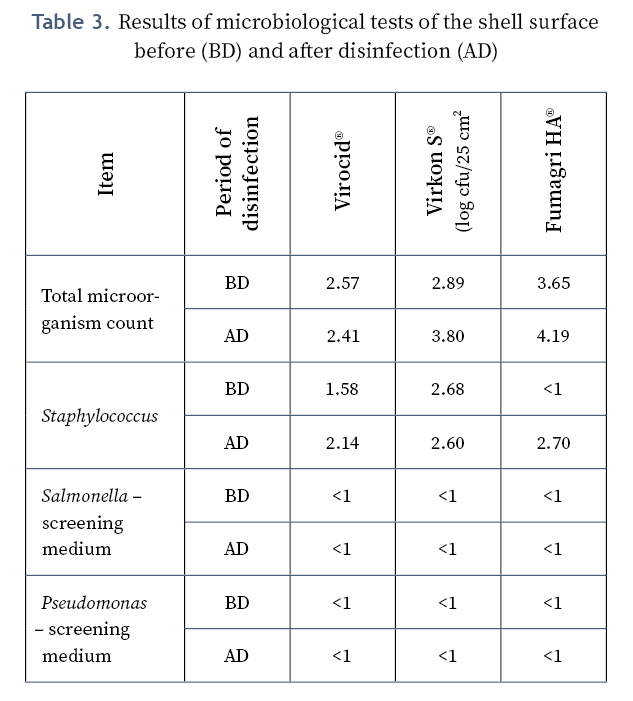
Results: Hatchability of fertile eggs was 83.3%, 86.0%, and 87.1% for Virocid®, Virkon S®, and Fumagri HA®, respectively, with no significant overall difference among treatments (p = 0.140). The distribution of embryonic mortality across incubation periods was also not significantly affected by the disinfection procedure (p = 0.130). Macroscopic signs of egg-content contamination were less frequent after Fumagri HA® than after Virocid® treatment (1.1% vs 3.3%; RR = 0.35). Microbiological analyses showed no consistent reduction in total microbial counts after disinfection. No colonies with morphology typical of Salmonella or Pseudomonas were detected on the screening media used.
Conclusions: The three disinfection procedures did not significantly differ in overall hatchability or embryonic mortality. However, Fumagri HA® was associated with the lowest frequency of macroscopically identified egg-content contamination. The lack of concordance between eggshell microbiological results and embryological outcomes indicates that hatchery disinfection should be evaluated using both microbiological and incubation-related criteria. Because the study involved a single commercial batch and limited microbiological replication, the findings should be regarded as preliminary.
Downloads
References
Stańko S, Mikuła A. Tendencje na rynku mięsa drobiowego na świecie i w Polsce w latach 2000–2016. Zeszyty Naukowe SGGW w Warszawie Problemy Rolnictwa Światowego. 2017;17(3):268–278. https://doi.org/10.22630/PRS.2017.17.3.72. DOI: https://doi.org/10.22630/PRS.2017.17.3.72 Google Scholar
Adame MM, Ameha N. Review on egg handling and management of incubation and hatchery environment. Asian Journal of Biological Sciences. 2023;16(4):474–484. https://doi.org/10.3923/ajbs.2023.474.484. DOI: https://doi.org/10.3923/ajbs.2023.474.484 Google Scholar
Kubaczyński A, Widz P, Batkowska J. Dezynfekcja jaj wylęgowych – tradycje i innowacje. In: Nowakowicz-Dębek B, Pawlak H, editors. Ergonomia. bezpieczeństwo i higiena pracy w praktyce. Lublin: TWN Libropolis; 2016. p. 243–253. Available from: https://www.researchgate.net/publication/335189519_Dezynfekcja_jaj_wylegowych_-_tradycje_i_innowacje. Google Scholar
Berrang ME, Cox NA, Frank JF, Buhr RJ. Bacterial penetration of the eggshell and shell membranes of the chicken hatching egg: A review. Journal of Applied Poultry Research. 1999;8(4):499–504. https://doi.org/10.1093/japr/8.4.499. DOI: https://doi.org/10.1093/japr/8.4.499 Google Scholar
De Reu K, Messens W, Heyndrickx M, Rodenburg TB. Uyttendaele M. Herman L. Bacterial contamination of table eggs and the influence of housing systems. World’s Poultry Science Journal. 2008;64(1):5–19. https://doi.org/10.1017/S0043933907001687. DOI: https://doi.org/10.1017/S0043933907001687 Google Scholar
Gantois I, Ducatelle R, Pasmans F, Haesebrouck F, Gast R, Humphrey TJ, Van Immerseel F. Mechanisms of egg contamination by Salmonella Enteritidis. FEMS Microbiology Reviews. 2009;33(4):718–738. https://doi.org/10.1111/j.1574-6976.2008.00161.x. DOI: https://doi.org/10.1111/j.1574-6976.2008.00161.x Google Scholar
Motola G, Hafez HM, Brüggemann-Schwarze S. Assessment of three alternative methods for bacterial disinfection of hatching eggs in comparison with conventional approach in commercial broiler hatcheries. PLoS One. 2023;18(3):e0283699. https://doi.org/10.1371/journal.pone.0283699. DOI: https://doi.org/10.1371/journal.pone.0283699 Google Scholar
Lesnierowski G, Borowiak R. Wpływ warunków środowiskowych na zmianę właściwości lizozymu w białku jaj kurzych. Żywność. Nauka. Technologia. Jakość. 2012;19:77–87. Google Scholar
Olsen R, Kudirkiene E, Thøfner I, Pors S, Karlskov-Mortensen P, Li L, Christensen J. Impact of egg disinfection of hatching eggs on the eggshell microbiome and bacterial load. Poultry Science. 2017;96(11):3901–3911. https://doi.org/10.3382/ps/pex182. DOI: https://doi.org/10.3382/ps/pex182 Google Scholar
World Health Organization. Salmonella (non-typhoidal). World Health Organization; 2018. Available from: https://www.who.int/en/news-room/fact-sheets/detail/salmonella-%28non-typhoidal%29. Google Scholar
Food Standards Agency. Salmonella risk profile of UK-produced hen shell eggs: Exposure assessment. Food Standards Agency; 2023. Available from: https://www.food.gov.uk/research/salmonella-risk-profile-of-uk-produced-hen-shell-eggs-exposure-assessment. Google Scholar
Watts A, Wigley P. Avian Pathogenic Escherichia coli: An overview of infection biology. Antimicrobial Resistance and Vaccination. Antibiotics. 2024;13(9):809. https://doi.org/10.3390/antibiotics13090809. DOI: https://doi.org/10.3390/antibiotics13090809 Google Scholar
Sharma S, Kaur S, Naguib M, Bragg A, Schneider A, Kulkarni RR, Nazmi A, Abdelaziz K. Major foodborne bacterial pathogens in poultry: Implications for human health and the poultry industry and risk mitigation strategies using probiotics. Microorganisms. 2025;13(10):2363. https://doi.org/10.3390/microorganisms13102363. DOI: https://doi.org/10.3390/microorganisms13102363 Google Scholar
Oliveira GDS, McManus C, Salgado CB, Dos Santos VM. Effects of sanitizers on microbiological control of hatching eggshells and poultry health during embryogenesis and early stages after hatching. Animals. 2022;12(20):2826. https://doi.org/10.3390/ani12202826. DOI: https://doi.org/10.3390/ani12202826 Google Scholar
Al-Shammari KIA, Batkowska J, Gryzińska M, Wlazło Ł, Ossowski M. Nowakowicz-Dębek B. The use of selected herbal preparations for the disinfection of Japanese quail hatching eggs. Poultry Science. 2022;101(10):102066. https://doi.org/10.1016/j.psj.2022.102066. DOI: https://doi.org/10.1016/j.psj.2022.102066 Google Scholar
Korowiecka K, Trela M, Tombarkiewicz B, Pawlak K, Niedziółka JW, Swadźba M, Lis MW. Ocena wpływu wybranych substancji stosowanych do dezynfekcji jaj wylęgowych na wyniki lęgu piskląt kurzych. Roczniki Naukowe Polskiego Towarzystwa Zootechnicznego. 2017;13(2):25–35. https://doi.org/10.5604/01.3001.0013.5221. DOI: https://doi.org/10.5604/01.3001.0013.5221 Google Scholar
Mohammadi-Aragh MK, Linhoss JE, Evans JD. Effects of various disinfectants on the bacterial load and microbiome of broiler hatching eggs using electrostatic spray. Journal of Applied Poultry Research. 2022;31(3):100278. https://doi.org/10.1016/j.japr.2022.100278. DOI: https://doi.org/10.1016/j.japr.2022.100278 Google Scholar
Board RG. Course of microbial infection of hens’ egg. Journal of Applied Bacteriology. 1966;29(2):319–323. https://doi.org/10.1111/j.1365-2672.1966.tb03482.x. DOI: https://doi.org/10.1111/j.1365-2672.1966.tb03482.x Google Scholar
Cook MI, Beissinger SR, Toranzos GA, Arendt WJ. Incubation reduces microbial growth on eggshells and the opportunity for trans-shell infection. Ecology Letters. 2005;8(5):532–537. https://doi.org/10.1111/j.1461-0248.2005.00748.x. DOI: https://doi.org/10.1111/j.1461-0248.2005.00748.x Google Scholar
Potter B, Hyde E, Pier HN, Rutter MA, Voss MA. A comparison of the bacterial microflora found on the surface of American kestrel and house wren eggs. The Open Ornithology Journal. 2014;7:40–48. DOI: https://doi.org/10.2174/1874453201407010040 Google Scholar
Ruiz-De-Castañeda R, Vela AI, González-Braojos S, Briones V, Moreno J. Drying eggs to inhibit bacteria: Incubation during laying in a cavity-nesting passerine. Behavioural Processes. 2011;88(2):142–148. https://doi.org/10.1016/j.beproc.2011.08.012. DOI: https://doi.org/10.1016/j.beproc.2011.08.012 Google Scholar
Hernández A, Martro E, Matas L, Martín M, Ausina V. Assessment of in-vitro efficacy of 1% Virkon® against bacteria. fungi. viruses and spores by means of AFNOR guidelines. Journal of Hospital Infection. 2000;46(3):203–209. https://doi.org/10.1053/jhin.2000.0818 DOI: https://doi.org/10.1053/jhin.2000.0818 Google Scholar
Kunanusont N, Punyadarsaniya D, Jantafong T, Pojprasath T, Takehara K, Ruenphet S. Bactericidal efficacy of potassium peroxymonosulfate under various concentrations. organic material conditions. exposure timing and its application on various surface carriers. Journal of Veterinary Medical Science. 2020;82(3):320–324. https://doi.org/10.1292/jvms.19-0562. DOI: https://doi.org/10.1292/jvms.19-0562 Google Scholar
Gerba CP, Boone S, Nims RW, Maillard JY, Sattar SA, Rubino JR. et al. Mechanisms of action of microbicides commonly used in infection prevention and control. Microbiology and Molecular Biology Reviews. 2024;88(3):e00205-22. https://doi.org/10.1128/mmbr.00205-22. DOI: https://doi.org/10.1128/mmbr.00205-22 Google Scholar
Sylte MJ, Chandra LC, Looft TO. Evaluation of disinfectants and antiseptics to eliminate bacteria from the surface of turkey eggs and hatch gnotobiotic poults. Poult Sci. 2017;96(7):2412–2420. https://doi.org/10.3382/ps/pex022. DOI: https://doi.org/10.3382/ps/pex022 Google Scholar
Samiullah S, Roberts JR. The eggshell cuticle of the laying hen. World’s Poultry Science Journal. 2014;70(4):693–708. https://doi.org/10.1017/S0043933914000786 DOI: https://doi.org/10.1017/S0043933914000786 Google Scholar
Kulshreshtha G, D'Alba L, Dunn IC, Réhault-Godbert S, Rodriguez-Navarro AB, Hincke MT. Properties, genetics and innate immune function of the cuticle in egg-laying species. Frontiers in Immunology. 2022;13:838525. https://doi.org/10.3389/fimmu.2022.838525 DOI: https://doi.org/10.3389/fimmu.2022.838525 Google Scholar
Otto M. Staphylococcal biofilms. Microbiology Spectrum. 2018;6(4). https://doi.org/10.1128/microbiolspec.gpp3-0023-20. DOI: https://doi.org/10.1128/microbiolspec.GPP3-0023-2018 Google Scholar
Flemming HC, Wingender J. The biofilm matrix. Nature Reviews Microbiology. 2010;8(9):623–633. https://doi.org/10.1038/nrmicro241.5 DOI: https://doi.org/10.1038/nrmicro2415 Google Scholar
Wu X, Wang H, Xiong J, Yang GX, Hu JF, Zhu Q, Chen Z. Staphylococcus aureus biofilm: Formulation, regulatory, and emerging natural products-derived therapeutics. Biofilm. 2024;7:100175. https://doi.org/10.1016/j.bioflm.2023.100175. DOI: https://doi.org/10.1016/j.bioflm.2023.100175 Google Scholar
Jones DR, Musgrove MT, Northcutt JK. Variations in external and internal microbial populations in shell eggs during extended storage. Journal of Food Protection. 2004;67(12):2657–2660. https://doi.org/10.4315/0362-028X-67.12.2657. DOI: https://doi.org/10.4315/0362-028X-67.12.2657 Google Scholar
Mousa-Balabel TM. Mohamed RA. Al-Midani SA. Abd El-Samad MS. Impact of boiler breeders hatching eggs disinfection time on some hatchability parameters. International Journal of Sciences: Basic and Applied Research. 2016;30(2):230–240. Google Scholar
Buffet-Bataillon S. Tattevin P. Bonnaure-Mallet M. Jolivet-Gougeon A. Emergence of resistance to antibacterial agents: the role of quaternary ammonium compounds – a critical review. International Journal of Antimicrobial Agents. 2012;39(5):381–389. https://doi.org/10.1016/j.ijantimicag.2012.01.011. DOI: https://doi.org/10.1016/j.ijantimicag.2012.01.011 Google Scholar
Brake J, Sheldon BW. Effect of a quaternary ammonium sanitizer for hatching eggs on their contamination, permeability, water loss, and hatchability. Poultry Science. 1990;69(4):517–525. https://doi.org/10.3382/ps.0690517. DOI: https://doi.org/10.3382/ps.0690517 Google Scholar
De Reu K. Grijspeerdt K. Messens W. Heyndrickx M. Uyttendaele M. Debevere J. Herman L. Eggshell factors influencing eggshell penetration and whole egg contamination by different bacteria including Salmonella Enteritidis. International Journal of Food Microbiology. 2006;112(3):253–260. https://doi.org/10.1016/j.ijfoodmicro.2006.04.011. DOI: https://doi.org/10.1016/j.ijfoodmicro.2006.04.011 Google Scholar
Cadirci S. Disinfection of hatching eggs by formaldehyde fumigation – a review. European Poultry Science. 2009;73(2):116–123. https://doi.org/10.1016/S0003-9098(25)00849-5. DOI: https://doi.org/10.1016/S0003-9098(25)00849-5 Google Scholar
Cabanillas-Beltrán H, González-Estrada RR, Gutiérrez-Martínez P, Hernández-López SM. Quality and microbiological protection of table eggs by ultrasonic application of acidic electrolyzed water and chitosan. Acta Agronómica. 2020;69(2):97–105. https://doi.org/10.15446/acag.v69n2.77436. DOI: https://doi.org/10.15446/acag.v69n2.77436 Google Scholar
Ibrahim FA, El-Mousafa MK, El Sabry MI, Badr JM. Hassan ASI. Effect of egg disinfection by silver nanoparticles on eggshell microbial load. hatchability and post-hatch performance of quail chicks. International Journal of Poultry Science. 2018;17(5):234–242. https://doi.org/10.3923/ijps.2018.234.242. DOI: https://doi.org/10.3923/ijps.2018.234.242 Google Scholar
Batkowska J, Al-Shammari KIA, Gryzińska MM. Assessment of ultraviolet light effect in hatching eggs disinfection on hatchability traits of two breeds of quails and chicken. Acta Scientiarum Polonorum Zootechnica. 2015;14(2):33–44. Google Scholar
Downloads
Published
How to Cite
Issue
Section
License
Copyright (c) 2026 Ewelina Węsierska, Magdalena Trela

This work is licensed under a Creative Commons Attribution-ShareAlike 4.0 International License.