A preliminary study on the spatial distribution of lead, cadmium, aluminium, and copper in different potato (Solanum tuberosum L.) varieties — implications for food safety and risk assessment
DOI:
https://doi.org/10.55225/sti.743Keywords:
heavy metals, potato, food safety, bioaccumulationAbstract
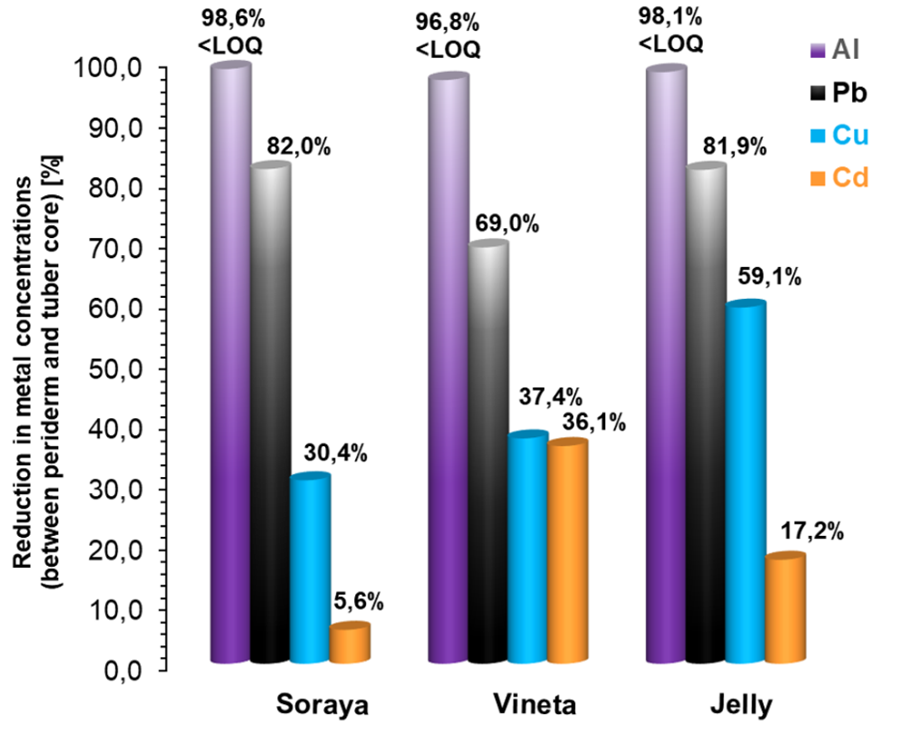
Food safety regarding heavy metal contamination is a critical global challenge due to the toxic nature of these elements and their ability to bioaccumulate in the food chain. This pilot study investigates the spatial distribution at different depths of potato tubers (Solanum tuberosum L.), of toxic elements such as lead and cadmium (both highly toxic) as well as aluminium (far less toxic compared to the previous two) and copper (micronutrient) to evaluate the efficacy of culinary processing in reducing toxic metal exposure. Three popular cultivars in southern Poland – “Soraya”, “Vineta”, and “Jelly” available on the Tarnów market were analyzed. Following the wet digestion step, the quantitative determination of selected metals was performed using Graphite–Furnace Atomic Absorption Spectrometry (Agilent 240Z AA). The accuracy of the analyses was validated using certified reference materials. The most interesting findings indicate that while mechanical peeling of tubers effectively minimizes exposure to Pb, it does not significantly reduce Cd levels. Analysis of behavior of aluminium revealed a distribution pattern similar to that observed for lead. Mechanical peeling led to a substantial reduction in the content of lead (69.0–82.0%) and aluminium (96.8–98.6%), as both elements strongly accumulated within the outermost periderm. Conversely, cadmium exhibited high mobility throughout the internal tissues, resulting in a minimal post-peeling concentration decrease ranging from 5.6% to 36.1%.
Downloads
References
WHO Foodborne Disease Burden Epidemiology Reference Group for 2021–2024: first report. Geneva; 2022. Google Scholar
Musilova J, Bystricka J, Vollmannova A, Volnova B, Hegedusova A. Factors affecting heavy metals accumulation in potato tubers. Environmental Protection and Natural Resources. 2015;26(3):54–9. https://doi.org/10.1515/oszn-2015-0018. DOI: https://doi.org/10.1515/oszn-2015-0018 Google Scholar
Voica C, Roba C, Molnár C. Heavy metal contamination and health risk assessment of potatoes in Romania. Journal of Food Composition and Analysis. 2025;148:108242. https://doi.org/10.1016/j.jfca.2025.108242. DOI: https://doi.org/10.1016/j.jfca.2025.108242 Google Scholar
Jadaa W, Mohammed H. Heavy metals – definition, natural and anthropogenic sources of releasing into ecosystems, toxicity, and removal methods – an overview study. Journal of Ecological Engineering. 2023;24(6):249–271. https://doi.org/10.12911/22998993/162955. DOI: https://doi.org/10.12911/22998993/162955 Google Scholar
Naveed S, Oladoye PO, Alli YA. Toxic heavy metals: A bibliographic review of risk assessment, toxicity, and phytoremediation technology. Sustainable Chemistry for the Environment. 2023;2:100018. https://doi.org/10.1016/j.scenv.2023.100018. DOI: https://doi.org/10.1016/j.scenv.2023.100018 Google Scholar
Jaishankar M, Tseten T, Anbalagan N, Mathew BB, Beeregowda KN. Toxicity, mechanism and health effects of some heavy metals. Interdisciplinary Toxicology. 2014;7(2):60–72. https://doi.org/10.2478/intox-2014-0009. DOI: https://doi.org/10.2478/intox-2014-0009 Google Scholar
Scutarașu EC, Trincă LC. Heavy metals in foods and beverages: Global situation, health risks and reduction methods. Foods. 2023;12(18):3340. https://doi.org/10.3390/foods12183340. DOI: https://doi.org/10.3390/foods12183340 Google Scholar
Tangahu BV, Sheikh Abdullah SR, Basri H, Idris M, Anuar N, Mukhlisin M. A review on heavy metals (As, Pb, and Hg) uptake by plants through phytoremediation. International Journal of Chemical Engineering. 2011:939161. https://doi.org/10.1155/2011/939161. DOI: https://doi.org/10.1155/2011/939161 Google Scholar
Abdullahi A, Lawal MA, Salisu AM. Heavy metals in contaminated soil: Source, accumulation, health risk and remediation process. Bayero Journal of Pure and Applied Sciences. 2021;14(1):1–12. https://doi.org/10.4314/bajopas.v14i1.1. DOI: https://doi.org/10.4314/bajopas.v14i1.1 Google Scholar
Mohamed HI, Ullah I, Toor MD, Tanveer NA, Din MMU, Basit A, Sultan Y, Muhammad M, Rehman MU. Heavy metals toxicity in plants: Understanding mechanisms and developing coping strategies for remediation: A review. Bioresources and Bioprocessing. 2025;12:95. https://doi.org/10.1186/s40643-025-00930-4. DOI: https://doi.org/10.1186/s40643-025-00930-4 Google Scholar
Clemens S. Toxic metal accumulation, responses to exposure and mechanisms of tolerance in plants. Biochimie. 2006;88(11):1707–1719. https://doi.org/10.1016/j.biochi.2006.07.003. DOI: https://doi.org/10.1016/j.biochi.2006.07.003 Google Scholar
Agency for Toxic Substances and Disease Registry (ATSDR) [Internet]. 2024 [cited 2026 Feb 1]. Substance Priority List 2022. Available from: https://www.atsdr.cdc.gov/programs/substance-priority-list.html. Google Scholar
Musilova J, Bystricka J, Lachman J, Harangozo L, Trebichalsky P, Volnova B. Potatoes: A crop resistant against input of heavy metals from the metallicaly contaminated soil. International Journal of Phytoremediation. 2016;18(6):547–552. https://doi.org/10.1080/15226514.2015.1086303. DOI: https://doi.org/10.1080/15226514.2015.1086303 Google Scholar
Musilova J, Hrabovska D, Volnova B, Polakova Z. Does consumption of potatoes cultivated in soils contaminated by heavy metals pose any risk to human health? Environmental Protection and Natural Resources. 2013;24:25–28. https://doi.org/10.2478/oszn-2013-0011. Google Scholar
Mushtaq G, Agrawal S, Kushwah A, Kumar A, Lone R. Cadmium toxicity in plants and its remediation management: A review. Plant Stress. 2025;16:100894. https://doi.org/10.1016/j.stress.2025.100894. DOI: https://doi.org/10.1016/j.stress.2025.100894 Google Scholar
Schrenk D, Bignami M, Bodin L, et al. Update of the risk assessment of inorganic arsenic in food. EFSA Journal. 2024;22(1):e8488. https://doi.org/10.2903/j.efsa.2024.8488. DOI: https://doi.org/10.2903/j.efsa.2024.p220101 Google Scholar
Singh S, Yadav R, Sharma S, Singh AN. Arsenic contamination in the food chain: A threat to food security and human health. Journal of Applied Biology and Biotechnology. 2023;11(4):24–33. https://doi.org/10.7324/JABB.2023.69922. DOI: https://doi.org/10.7324/JABB.2023.69922 Google Scholar
Visciano P. Arsenic in water and food: Toxicity and human exposure. Foods. 2025;14(13):4–6. https://doi.org/10.3390/foods14132229. DOI: https://doi.org/10.3390/foods14132229 Google Scholar
Muszyńska M, Jaworska-Bieniek K, Durda K, Sukiennicki G, Gromowski T, Jakubowska A, Morawski A, Lubiński J. Arsenic (As) and breast cancer risk. Hereditary Cancer in Clinical Practice. 2012;10(Suppl 4):A8. https://doi.org/10.1186/1897-4287-10-s4-a8. DOI: https://doi.org/10.1186/1897-4287-10-S4-A8 Google Scholar
Kumar A, Kumar A, Cabral-Pinto MMS, Chaturvedi AK, Shabnam AA, Subrahmanyam G, Mondal R, Gupta DK,Malyan SK, Kumar SS, Kjan SA, Yadav KK. Lead toxicity: Health hazards, influence on food chain, and sustainable remediation approaches. International Journal of Environmental Research and Public Health. 2020;17(7):2179. https://doi.org/10.3390/ijerph17072179. DOI: https://doi.org/10.3390/ijerph17072179 Google Scholar
Ociepa-Kubicka A, Ociepa E. Toksyczne oddziaływanie metali ciężkich na rośliny, zwierzęta i ludzi. Inżynieria i Ochrona Środowiska. 2012;15(2):169–180. Google Scholar
Charkiewicz AE, Backstrand JR. Lead toxicity and pollution in Poland. International Journal of Environmental Research and Public Health. 2020;17(12):1–16. https://doi.org/10.3390/ijerph17124385. DOI: https://doi.org/10.3390/ijerph17124385 Google Scholar
Wani AL, Ara A, Usmani JA. Lead toxicity: A review. Interdisciplinary Toxicology. 2015;8(2):55–64. https://doi.org/10.1515/intox-2015-0009. DOI: https://doi.org/10.1515/intox-2015-0009 Google Scholar
Yruela I. Copper in plants: Acquisition, transport and interactions. Functional Plant Biology. 2009;36(5):409–430. https://doi.org/10.1071/FP08288. DOI: https://doi.org/10.1071/FP08288 Google Scholar
LeRiche EL, Wang-Pruski G, Zheljazkov VD. Distribution of elements in potato (Solanum tuberosum L.) tubers and their relationship to after-cooking darkening. HortScience. 2009:1866–1873. https://doi.org/10.21273/HORTSCI.44.7.1866. DOI: https://doi.org/10.21273/HORTSCI.44.7.1866 Google Scholar
Górska-Warsewicz H, Rejman K, Kaczorowska J, Laskow-ski W. Vegetables, potatoes and their products as sources of energy and nutrients to the average diet in poland. International Journal of Environmental Research and Public Health. 2021;18(6):1–23. https://doi.org/10.3390/ijerph18063217. DOI: https://doi.org/10.3390/ijerph18063217 Google Scholar
Dzwonkowski W. Rynek ziemniaka stan i perpektywy. Analizy Rynkowe IERiGŻ PIB. 2024;51. DOI: https://doi.org/10.33226/1231-7853.2024.7.5 Google Scholar
Sawicka B, Pszczółkowski P, Messaoudi M, Skiba D, Barbaś P, Krochmal-Marczak B, Noaema AH. Genotype, environment, and heavy metals: Variability of the content of elements in 40 potato varieties from Central-Eastern Poland. Chemistry and Biodiversity. 2025;22(6):e202403337. https://doi.org/10.1002/cbdv.202403337. DOI: https://doi.org/10.1002/cbdv.202403337 Google Scholar
Gambuś F, Rak M, Wieczorek J. Heavy metals phytoavailability in the soils of the ecologically endangered regions in the province of Tarnów. Acta Agrophysica. 2001;51:221–230. Google Scholar
Wódkowska A, Gruszecka-Kosowska A. Dietary exposure to potentially harmful elements in edible plants in Poland and the health risk dynamics related to their geochemical differentiation. Scientific Reports. 2023;13(1):8521. https://doi.org/10.1038/s41598-023-35647-x. DOI: https://doi.org/10.1038/s41598-023-35647-x Google Scholar
European Commission. Commission Regulation (EU) 2023/915 of 25 April 2023 on maximum levels for certain contaminants in food and repealing Regulation (EC) No 1881/2006 [Internet]. Official Journal of the European Union; 2023 Apr 25. p. 103–57. Available from: http://data.europa.eu/eli/reg/2023/915/oj Google Scholar
Norton GJ, Deacon CM, Mestrot A, Feldmann J, Jenkins P, Baskaran C, et al. Cadmium and lead in vegetable and fruit produce selected from specific regional areas of the UK. Science of the Total Environment. 2015;533:520–527. https://doi.org/10.1016/j.scitotenv.2015.06.130. DOI: https://doi.org/10.1016/j.scitotenv.2015.06.130 Google Scholar
Subramanian NK, White PJ, Broadley MR, Ramsay G. The three-dimensional distribution of minerals in potato tubers. Annals of Botany. 2011;107(4):681–691. https://doi.org/10.1093/aob/mcr009. DOI: https://doi.org/10.1093/aob/mcr009 Google Scholar
Chudzik B, Szczuka E, Leszczuk A, Strubińska J. Modification of pectin distribution in sunflower (Helianthus annuus L.) roots in response to lead exposure. Environmental and Experimental Botany. 2018;155:251–259. https://doi.org/10.1016/j.envexpbot.2018.07.005. DOI: https://doi.org/10.1016/j.envexpbot.2018.07.005 Google Scholar
Reid RJ, Dunbar KR, McLaughlin MJ. Cadmium loading into potato tubers: The roles of the periderm, xylem and phloem. Plant, Cell and Environment. 2003;26(2):201–206. https://doi.org/10.1046/j.1365-3040.2003.00945.x. DOI: https://doi.org/10.1046/j.1365-3040.2003.00945.x Google Scholar
Downloads
Published
How to Cite
Issue
Section
License
Copyright (c) 2026 Michał Marek, Dominik Zdzieszyński, Piotr Simajchel, Krzysztof Kleszcz

This work is licensed under a Creative Commons Attribution-ShareAlike 4.0 International License.