
Safety management of transport systems
DOI:
https://doi.org/10.55225/sti.647Słowa kluczowe:
zarządzanie bezpieczeństwem, system transportowy, transport kolejowy, ryzyko wypadków komunikacyjnych, analiza ryzyka, bezpieczeństwoAbstrakt
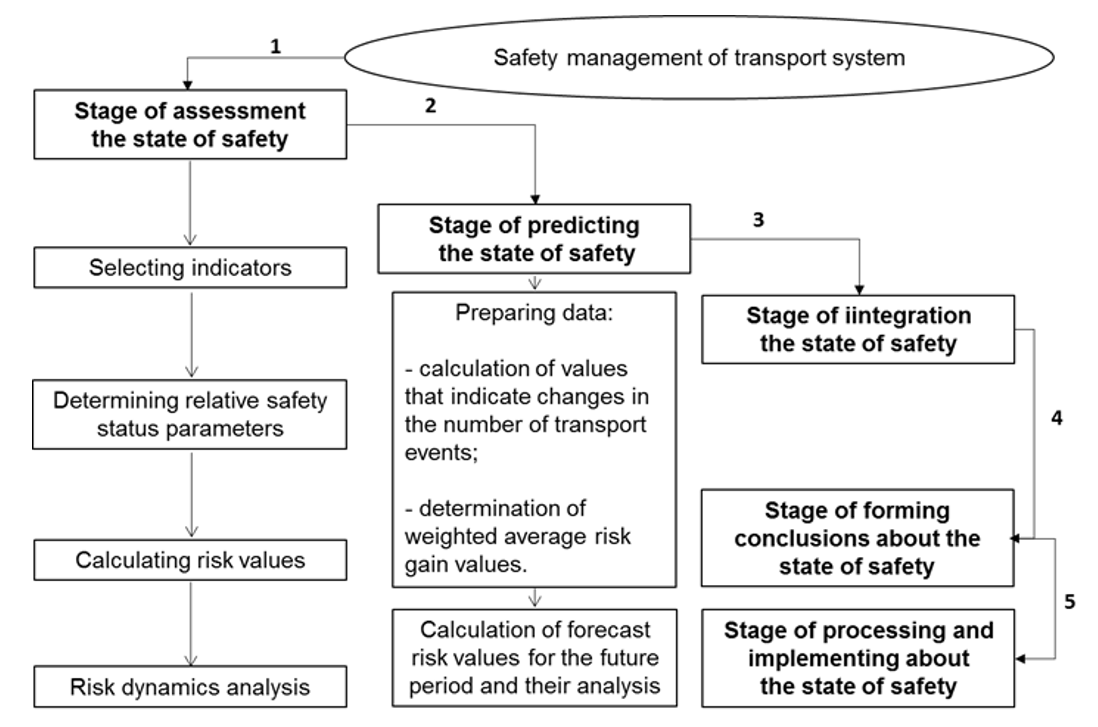
The importance of scientific research on the functioning and safety of transport systems cannot be overstated. Addressing scientific challenges in this field is essential for advancing a country's economic, technical, and technological development. Evolving operational conditions in transport systems present new and complex challenges for research, particularly as the transport sector increasingly contributes to critical state functions such as humanitarian support, defence, and social services. This study presents a methodology for managing transport system safety, with a particular focus on wartime conditions, where risk levels are significantly higher. The proposed methodology includes an assessment of the current state of transport system safety, risk forecasting, and the definition of a comprehensive risk indicator. This work contributes to the existing literature by expanding research on the management of transport system safety under high-risk conditions, characterized by a high probability of external interference and the presence of atypical operating environments.
Statystyka pobrań
Bibliografia
Bulakh M, Okorokov A, Baranovskyi D. Risk System and Railway Safety. IOP Conference Series: Earth and Environmental Science. 2021;666:042074. https://doi.org/ 10.1088/1755-1315/666/4/042074. DOI: https://doi.org/10.1088/1755-1315/666/4/042074 Google Scholar
Baranovskyi D, Myamlin S, Kebal I. (2022). Increasing the carrying capacity of the solid-body rail freight car. Advances in Science and Technology Research Journal. 2022;16(3):219–225. https://doi.org/10.12913/22998624/149935. DOI: https://doi.org/10.12913/22998624/149935 Google Scholar
Lingaitis LP, Mjamlin S, Baranovsky D, Jastremskas V. Experimental investigations on operational reliability of diesel locomotives engines. Eksploatacja i Niezawodność – Maintenance and Reliability. 2012;14(1):6–11. Google Scholar
Lingaitis LP, Mjamlin S, Baranovsky D, Jastremskas V. Prediction methodology of durability of locomotives diesel engines. Eksploatacja i Niezawodność – Maintenance and Reliability. 2012;14(2):154–159. Google Scholar
Baranovskyi D, Myamlin S, Bulakh M, Podosonov D, Muradian L. (2022). Determination of the filler concentration of the composite tape. Applied Sciences. 2022;12(21):1–15. https://doi.org/10.3390/app122111044. DOI: https://doi.org/10.3390/app122111044 Google Scholar
Baranovskyi D, Bulakh M, Myamlin S, Kebal I. New design of the hatch cover to increase the carrying capacity of the gondola car. Advances in Science and Technology Research Journal. 2022;16(6):186–191. https://doi.org/10.12913/22998624/156205. DOI: https://doi.org/10.12913/22998624/156205 Google Scholar
Newaz MT, Ershadi M, Jefferies M, Davis P. Assessing safety management factors to develop a research agenda for the construction industry. Safety Science. 2021;142:105396. https://doi.org/10.1016/j.ssci.2021.105396. DOI: https://doi.org/10.1016/j.ssci.2021.105396 Google Scholar
Su W-J. The effects of safety management systems, attitude and commitment on safety behaviors and performance. International Journal for Applied Information Management. 2021;1(4):187–200. DOI: https://doi.org/10.47738/ijaim.v1i4.20 Google Scholar
Read GJ, Naweed A, Salmon, PM. Complexity on the rails: A systems-based approach to understanding safety management in rail transport. Reliability Engineering and System Safety. 2019;188:352–365. DOI: https://doi.org/10.1016/j.ress.2019.03.038 Google Scholar
Gura DA, Dubenko YV, Shevchenko GG, Dyshkant EE, Khusht NI. Three-dimensional laser scanning for safety of transport infrastructure with application of neural network algorithms and methods of artificial intelligence. In: Petriaev A, Konon A, editors. Transportation Soil Engineering in Cold Regions, Volume 2. Lecture Notes in Civil Engineering, vol 50. Singapore: Springer; 2020. p. 185–190. https://doi.org/10.1007/978-981-15-0454-9_19. DOI: https://doi.org/10.1007/978-981-15-0454-9_19 Google Scholar
Fang W, Ding L, Love PED, Luo H, Li H, Peña-Mora F, Zhong B, Zhou C. Computer vision applications in construction safety assurance. Automation in Construction. 2020;110:1–10. https://doi.org/10.1016/j.autcon.2019.103013. DOI: https://doi.org/10.1016/j.autcon.2019.103013 Google Scholar
Bartulović D. Predictive safety management system development. Transactions on Maritime Science. 2021;10(01):135–146. https://doi.org/10.7225/toms.v10.n01.010. DOI: https://doi.org/10.7225/toms.v10.n01.010 Google Scholar
Ancel E, Shih AT, Jones SM, Reveley MS, Luxhøj JT, Evans JK. (2015). Predictive safety analytics: Inferring aviation accident shaping factors and causation. Journal of Risk Research. 2015;18(4):428–451. https://doi.org/10.1080/13669877.2014.896402. DOI: https://doi.org/10.1080/13669877.2014.896402 Google Scholar
Pobrania
Opublikowane
Jak cytować
Numer
Dział
Licencja
Prawa autorskie (c) 2025 Maryna Bulakh, Oleksandra Baranovska

Utwór dostępny jest na licencji Creative Commons Uznanie autorstwa – Na tych samych warunkach 4.0 Miedzynarodowe.