Developing a conceptual simulation model to analyze and improve traffic flows of the multimodal terminal "RIX" and decision-making for the formation of a new transport hub
DOI:
https://doi.org/10.55225/sti.650Keywords:
multimodality, hubs, RIX, Rail Baltica, passenger, traffic flows, conceptual simulation model, optimizationAbstract
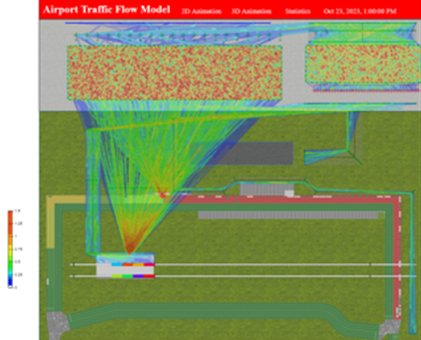
The article explores the development of a simulation model as a decision support tool to aid the planning and development of a new multimodal transport hub at Riga International Airport (RIX), considering its integration with the Rail Baltica project. The study addresses the growing significance of multimodality in enhancing connectivity, passenger service quality, and infrastructure efficiency at major air transport hubs. The air transport system – comprising both demand-side (passengers, freight) and supply-side (airports, airlines, air traffic control) components - has long been affected by capacity constraints, congestion, and environmental issues. These challenges have persisted and, in some cases, intensified in the post-pandemic recovery period.
The aim of the study is to develop a conceptual simulation model that supports tactical decision-making for traffic flow optimization and infrastructure development at RIX. The research emphasizes complementary role of rail transport in multimodal integration, particularly its potential to extend air connectivity and enable seamless “door-to-door” travel chain. Best practices in multimodality at Helsinki and Singapore airports are reviewed. The current state of infrastructure and intermodal connectivity at RIX is analyzed, especially with reference to its future connection to the planned Rail Baltica line.
A holistic approach to service level analysis is applied, incorporating both terminal and regional access components. Given the complexity of such large-scale projects, modern model-based tools are essential for evaluating alternative scenarios and supporting planning decisions. The proposed conceptual simulation model provides a methodological framework for evaluating multimodal passenger flows and supports strategic decisions on hub development and infrastructure optimization.
Downloads
References
Rodrigue J-P, Comtois C, Slack B. The Geography of Transport Systems. Routledge; 2020.
Keeney RL, Raiffa H. Decisions with Multiple Objectives: Preferences and Value Trade-Offs. Cambridge University Press; 1993.
Turban E, Sharda R, Delen D. Decision Support and Business Intelligence Systems. Pearson Education; 2014.
European Commission: White Paper: Roadmap to a Single European Transport Area – Towards a competitive and resource efficient transport system Brussels [Internet]. 2021 March 28 [cited 2024 Oct. 16]. Available from: https://eur-lex.europa.eu/legal-content/EN/TXT/?uri=celex:52011DC0144.
Ortuzar JD, Willumsen LG. Modelling Transport. John Willey & Sons; 2006.
Savrasovs M, Yatskiv I, Tolujevs Y, Jackson I. (2020), Simulation as a decision supporting tool for airport planning: Riga International Airport case study. Transport. 2021;36(6):474––485. https://doi.org/10.3846/transport.2021.16198.
Rail Baltica. (2024). Ministry of Transport of the Republic of Latvia.
TVNET. Rail Baltica deadlines extended again: Latvia loses over €17 million in unused EU funding. 2024 [cited 2024 Dec. 12]. Available from: https://www.tvnet.lv/7998447/.
Downloads
Published
Issue
Section
License
Copyright (c) 2025 Sofija Kostina, Konstantins Savenkovs, Vladimirs Reiskarts

This work is licensed under a Creative Commons Attribution-ShareAlike 4.0 International License.