
Modeling and measurement methods for multi-source heat pumps
DOI:
https://doi.org/10.55225/sti.314Keywords:
multi-source heat pump, heat pump modellingAbstract
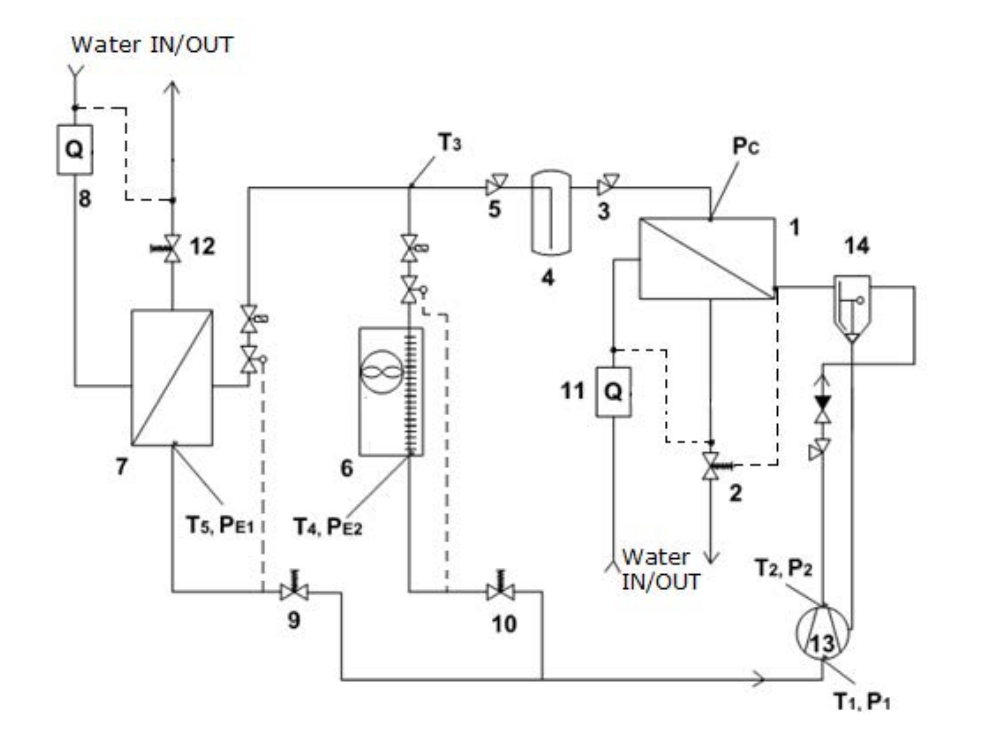
Multi-source heat pumps are gaining prominence as energy prices rise and environmental efforts intensify. This type of heat pump system can be used for industrial processes as well as for heating. However, it is a challenge to properly model the two heat sources, possibly operating in parallel, to provide the appropriate input parameters for the design process. The aim of our work is to compile a system that is suitable for the parallel operation of two heat sources. We can compare the measured data with the results of the software used for modeling.
Downloads
References
Ghabour R, Korzenszky P. Mathematical modelling and experimentation of soy wax PCM solar tank using response surface method. Analecta Technica Szegedinensia. 2020; 14(2):35–42. https://doi.org/10.14232/analecta.2020.2.35-42.
Qor-El-Aine A, Béres A, Géczi G. The nitrogen dioxide (NO2) and PM10 pollution level in Debrecen, Miskolc, and Nyíregyháza Hungary in the previous 4 years. Hungarian Agricultural Research. 2021;1:3–10
Páger Sz, Veres A, Géczi G. Basic connections of heating and cooling systems. Part 3: Quality control. Hungarian Installateur. 2021;31:42–44
Chao H, Shengteng L, Fenghao W, Lang L, Yujiao Z, Zhihua W, Pengfei T. Performance analysis of a combined solar-assisted heat pump heating system in Xi’an, China. Energies. 2019;12(2515):3–20. https://doi.org/10.3390/en12132515.
Bartha S, Lágymányosi A, Farkas I. Combined photovoltaic-wind electricity generation in an economy not connected to the electricity grid. Magyar Energetika. 2002;10(6):21–26
Junfang X, Yaohua Z, Zhenhua Q, Gang W, Jieteng W. Air–water dual-source heat pump system with new composite evaporator. Applied Thermal Engineering. 2018;141:483–493. https://doi.org/10.1016/j.applthermaleng.2017.11.128.
Han Z, Lejian Q, Xiao M, Xiaobei S, Changming M. Simulation of a multi-source hybrid heat pump system with seasonal thermal storage in cold regions. Applied Thermal Engineering. 2017;116:292–302. https://doi.org/10.1016/j.applthermaleng.2017.01.057.
Buker M, Saffa R. Solar assisted heat pump systems for low temperature water heating applications: A systematic review. Renewable and Sustainable Energy Reviews. 2016;55:399–413. https://doi.org/10.1016/j.rser.2015.10.157.
Corberán JM, Antonio C-M, Javier M-A, Carola M. Dual source heat pump, a high efficiency and cost-effective alternative for heating, cooling and DHW production. International Journal of Low-Carbon Technologies. 2018;13: 161–176. https://doi.org/10.1093/ijlct/cty008.
Hermanucz P, Géczi G, Barótfi I. Hűtőközeg váltás hőszivattyúra gyakorolt hatásának mérési lehetőségei. Jelenkori társadalmi és gazdasági folyamatok. 2019;2:71–77.
Jakab Z. Compressor Cooling. Budapest: HKVSZ Publishing House; 2006.
Makhnatcha P, Khodabandeha R. The role of environmental metrics (GWP, TEWI, LCCP) in the selection of low GWP refrigerants. Energy Procedia. 2014;61:2460–2463. https://doi.org/10.1016/j.egypro.2014.12.023.
Downloads
Published
Issue
Section
License
Copyright (c) 2021 Authors

This work is licensed under a Creative Commons Attribution-ShareAlike 4.0 International License.