
Entropy-probabilistic model for controlling the human factor in the system of ensuring the airworthiness of aircraft and their components
DOI:
https://doi.org/10.55225/sti.658Keywords:
airworthiness, aircraft, human factor, ranking, procedure management, entropy, non-conformance in activitiesAbstract
The following issues are addressed in the paper:
- A mathematical model for controlling human factors in the aircraft maintenance system is proposed, aimed at identifying priority tasks in maintaining airworthiness under conditions of limited resources.
- The model is developed using factor analysis under uncertainty, employing the entropy ranking method. In this approach, non-conformances in the activities of technical personnel (violations and errors) are represented as a multidimensional random generalized factor that comprises several measurable specific factors. The task of the management system is to determine the entropy of the generalized factor based on these measurable components.
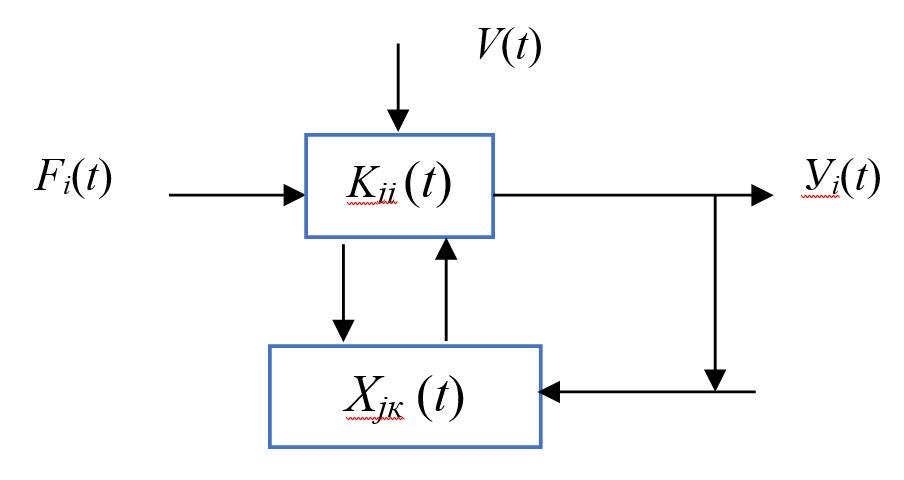
- A functional diagram of the control system is developed based on a systems approach, considering it as a dynamic system that, at each moment, is described by a set of physical variables (parameters).
- Based on statistical data on deviations in the activities of airline technical personnel collected over a 10-year period, entropy indicators were obtained for several logically grouped factors—generalized indicators characterizing the main areas of management activities related to the continuing airworthiness of aircraft.
- The results make it possible to identify the main areas of preventive activities within the airline aimed at reducing the negative impact of human factors during aircraft maintenance, which is particularly important under conditions of limited resources.
Downloads
References
ICAO. Airworthiness of Aircraft: Annex 8 to the Convention on International Civil Aviation. 12th ed. International Standards and Recommended Practices. International Civil Aviation Organization; 2018. [cited 2025-05-20]. Available form: https://applications.icao.int/postalhistory/annex_8_airworthiness_of_aircraft.htm. Google Scholar
IATA. One Size does not Fit All: A Study of How Airline Business Models Have Evolved to Meet Demands in Europe. International Air Transport Association; 2024 [cited 2025-05-20]. Available from: https://www.iata.org/en/iata-repository/publications/economic-reports/one-size-does-not-fit-all---airline-business-models/. Google Scholar
ICAO. Air Transport Policy and Regulation. International Civil Aviation Organization; 2019 [cited 2025-05-20]. Available form: https://www.icao.int/sustainability/pages/economic-policy.aspx. Google Scholar
IATA, Balancing Fleet Age for Efficiency and Sustainable Growth. International Air Transport Association; 2023 [cited 2025-05-20]. Available from: https://www.iata.org/en/iata-repository/publications/economic-reports/chart-of-the-week-8-sep/. Google Scholar
IATA Annual Review 2024. International Air Transport Association; 2024 [cited 2025-05-20]. Available from: https://www.iata.org/contentassets/c81222d96c9a4e0bb4ff6ced0126f0bb/iata-annual-review-2024.pdf. Google Scholar
ICAO Annual Safety Report Group 6th Meeting (ASRG/6). International Civil Aviation Organization; 2024 [cited 2025-05-20]. Available from: https://www.icao.int/MID/Documents/2024/ASRG6/WP3.pdf. Google Scholar
ICAO. Doc 9760: Airworthiness Manual. 3rd ed. International Civil Aviation Organization; 2014. Google Scholar
EASA. Continuing Airworthiness. European Union Aviation Safety Agency [cited2025-05-20]. Available from: https://www.easa.europa.eu/en/the-agency/faqs/continuing-airworthiness. Google Scholar
EASA. Easy Access Rules for Continuing Airworthiness (Regulation [EU] N 1321/2014): Revision from July 2024. European Union Aviation Safety Agency; 2024 [cited 2025-05-20]. Available from: https://www.easa.europa.eu/en/document-library/easy-access-rules/online-publications/easy-access-rules-continuing-airworthiness. Google Scholar
De Florio F. Chapter 9: Continued airworthiness and operation. In: F. De Florio. Airworthiness: An Introduction to Aircraft Certification. Elsevier; 2011:243–319. https://doi.org/10.1016/B978-0-08-096802-5.10009-1. DOI: https://doi.org/10.1016/B978-0-08-096802-5.10009-1 Google Scholar
EASA. Easy Access Rules for Continuing Airworthiness (Regulation [EU] N 1321/2014): Revision from July 2024: Annex I (Part-M). . European Union Aviation Safety Agency; 2024 [cited 2025-05-20]. Available from: https://www.easa.europa.eu/en/document-library/easy-access-rules/online-publications/easy-access-rules-continuing-airworthiness?page=3&kw=Part-M. Google Scholar
Kinnison HA, Siddiqui T. Aviation Maintenance Management. McGraw-Hill Education; 2013. Available from: https://commons.erau.edu/publication/1538/. Google Scholar
Ickovic AA, Fajnburg IA. Upravlenie processami tehniceskoj ekspluatacii letatelnyh apparatov. Moscow: MGTU GA; 2012. Google Scholar
Shestakov V. Cilvēka faktors aviācijā. RTU Izdevniecība; 2011. ISBN 978-9934-10-196-0. Google Scholar
NASA, ASRS—Aviation Safety Reporting System: Program Briefing. NASA; 2011 [cited 2025-05-20]. Available from: http://asrs.arc.nasa.gov/overview/summary.html. Google Scholar
Bitiņš A. Development of Theoretical and Methodological Approaches to Flight Safety Information Base Systems [doctoral thesis]. Riga: Riga Technical University Press; 2022. https://doi.org/10.7250/9789934227646. DOI: https://doi.org/10.7250/9789934227646 Google Scholar
Marais KB, Robichaud MR. Analysis of trends in aviation maintenance risk: An empirical approach. Reliability Engineering and System Safety. 2012;106:104–118. https://doi.org/10.1016/j.ress.2012.06.003. DOI: https://doi.org/10.1016/j.ress.2012.06.003 Google Scholar
NASA. ASRS—Aviation Safety Reporting System: Program Briefing. NASA; 2024 [cited 2025-05-20]. Available from: http://asrs.arc.nasa.gov/overview/summary.html. Google Scholar
FAA. Chapter 14: Human factors. In: Aviation Maintenance Technician Handbook: General (FAA-H-8083-30B). U.S. Department of Transportation, Federal Aviation Administration, Airman Testing Standards Branch; 2023:14-1–14-31. Available from: https://www.faa.gov/regulations_policies/handbooks_manuals/aviation/amtg_handbook.pdf Google Scholar
University of Cambridge. Improving Improvement: A toolkit for Engineering Better Care: What is a Systems Approach? [cited 2025-05-20]. Available from: https://www.iitoolkit.com/start/systems.html#:~:text=A%20systems%20approach%20is%20a,relationships%20and%20interactions%20between%20them. Google Scholar
Majchrzak J. Qualitology: The Issue of Quality and its Assessment. European Research Studies Journal. 2021;24(2 special issue, part 3):28–298. https:doi.org/10.35808/ersj/2733. DOI: https://doi.org/10.35808/ersj/2733 Google Scholar
Wu YR, Duanmu JS, Xu JH, Ren XH. Aviation human factors accident causation model based on structure entropy. Advances in Materials Science and Engineering. 2014;488–489:1354–1357. https://doi.org/10.4028/www.scientific.net/AMM.488-489.1354. DOI: https://doi.org/10.4028/www.scientific.net/AMM.488-489.1354 Google Scholar
Sokolova IS, Tyrsin AN. Use of entropy-probabilistic modeling in problems of monitoring and management of complex systems. Sovremennye Tehnologii. Sistemnyj analiz. Modelirovanie. 2012;4(36):35–40. Available from: https://cyberleninka.ru/article/n/ispolzovanie-entropiyno-veroyatnostnogo-modelirovaniya-v-zadachah-monitoringa-i-upravleniya-slozhnymi-sistemami. Google Scholar
Pihnastyi O, Zaruba V. Entropy approach to the description of technological processes. Vìsnik Shìdnoukraïns’kogo nacìonal’nogo unìversitetu ìmenì Volodimira Dalâ. 2011;156:219–225. Available from: https://papers.ssrn.com/sol3/papers.cfm?abstract_id=3453457. Google Scholar
Zhang Z, Liu B, Liu Y, Zhang H. Fault feature-extraction method of aviation bearing based on maximum correlation Re’nyi entropy and phase-space reconstruction technology. Entropy; 2022;24(10):1459. https://doi.org/10.3390/e24101459. DOI: https://doi.org/10.3390/e24101459 Google Scholar
Tyrsin AN, Vorfolomeeva OV. Study of the dynamics of multidimensional stochastic systems based on entropy modeling. Informatics and Applications. 2013;7(4):3-10. Google Scholar
Vaivads V, Gorbacovs O, Sestakov V. Relationship between professionally important qualities of aviation technical personnel and flight safety. In: Gorbacovs O, Arandas I, editors. Proceedings of the International Scientific Conference Engineering and Transport Services – 2014: Aviation Engineers Training Reqouirements in Europen Unionenvironment: 25th July 2014. Riga: Rigas Aeronavigacijas Instituts; 2014:12–19. Google Scholar
Terescenko J, Bitins A, Shestakov V, Chatys R, Maklakov J. Algorithm for analyzing deviations and irregularities in the functioning of the airline’s structural units and personnel in the face of uncertainty. Aviation. 2020;24(2):51–56, 2020. https://doi.org/10.3846/aviation.2020.12375. DOI: https://doi.org/10.3846/aviation.2020.12375 Google Scholar
Downloads
Published
How to Cite
Issue
Section
License
Copyright (c) 2025 Ibrahims Arandas, Vladimir Shestakov, Kirils Kļepackis, Ilmārs Blumbergs, Raivis Kubulins, Jevgenijs Tereščenko, Yasaratne Dissanayake

This work is licensed under a Creative Commons Attribution-ShareAlike 4.0 International License.