Essential and non-mutagenic elements in raw ewe milk
DOI:
https://doi.org/10.55225/sti.316Keywords:
macroelements, microelements, risk elements, metals, non-mutagenic elements, ruminants, ewe milkAbstract
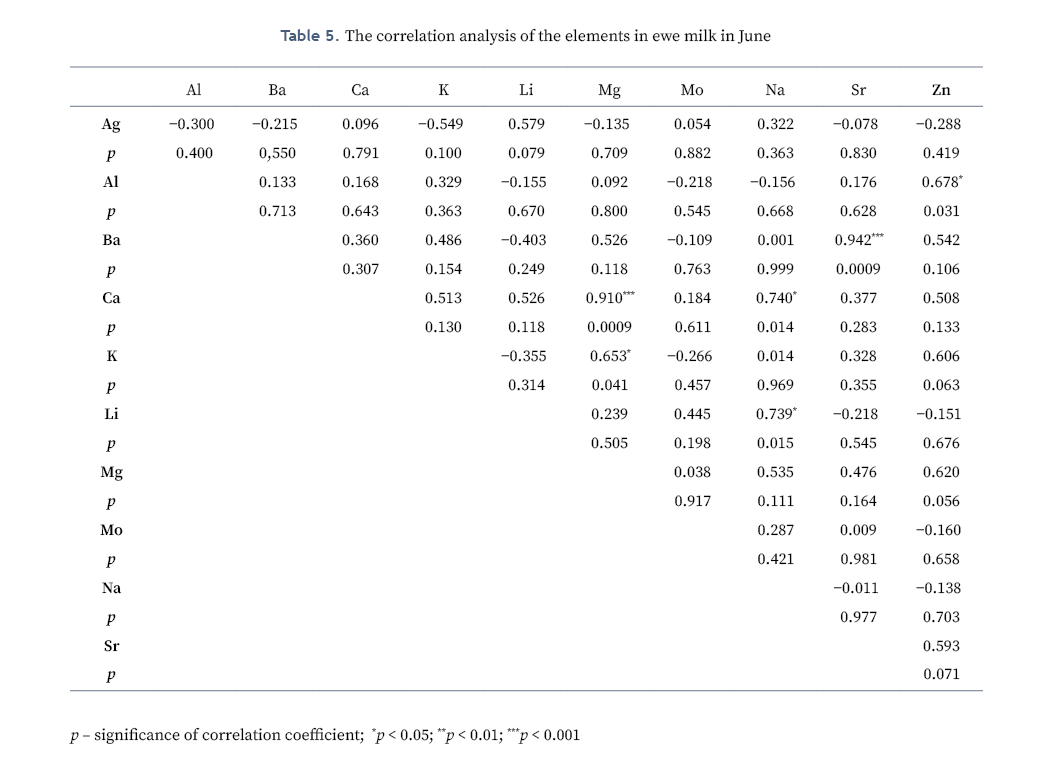
The monitoring of metals and other chemical elements in the basic sources of diet, mainly for children, is very important for preventing health issues. The aim of this work was to determine the concentration of selected essential (Ca, K, Mg, Mo, Na, Zn) and non-mutagenic elements (Ag, Al, Ba, Li, Sb, Sr) in ewe milk from the Orava region in northern Slovakia. Twenty milk samples were analysed in June and August using an inductively-coupled plasma optical emission spectrometry. The differences in elements concentration between the seasonal periods were not significant (p < 0.05), except for lithium (p < 0.05). The essential elements concentration was within the recommended levels, while the non-mutagenic and potentially toxic metals consist was under the permissible limits. However, there were found very strong and significant relationships between the elements which may suggest the synergistic / additive or antagonistic effects of some elements.
Downloads
References
Abilleira E, Virto M, Nájera AI, Salmerón J, Albisu M, Pérez-Elortondo FJ, Ruiz de Gordoa JC, de Renobales M, Barron LJ. Effects of seasonal changes in feeding management under part-time grazing on the evolution of the composition and coagulation properties of raw milk from ewes. Journal of Dairy Science. 2010;93(9):3902–3909. https://doi.org/10.3168/jds.2009-2983.
Rako A, Kalit MT, Kalit S. Effect of sheep’s milk composition on strength and syneresis of rennet-induced milk gel during lactation. Food Technology and Biotechnology. 2019;57(3):426–433. https://doi.org/10.17113/ftb.57.03.19.6218.
Park YW, Juárez M, Ramos M, Haenlein GFW. Physico-chemical characteristics of goat and sheep milk. Small Ruminant Research. 2007;68(1–2):88–113. https://doi.org/10.1016/j.smallrumres.2006.09.013.
Pilarczyk R, Wójcik J, Czerniak P, Sablik P, Pilarczyk B, Tomza-Marciniak A. Concentrations of toxic heavy metals and trace elements in raw milk of Simmental and Holstein-Friesian cows from organic farm. Environmental Monitoring and Assessment. 2013;185(10):8383–8392. https://doi.org/10.1007/s10661-013-3180-9.
Toffanin V, Penasa M, McParland S, Berry DP, Cassandro M, De Marchi M. Genetic parameters for milk mineral content and acidity predicted by mid-infrared spectroscopy in Holstein-Friesian cows. Animals. 2015;9(5):775–780. https://doi.org/10.1017/S1751731114003255.
Capcarova M, Binkowski LJ, Stawarz R, Schwarczova L, Massanyi P. Levels of essential and xenobiotic elements and their relationships in milk available on the Slovak market with the estimation of consumer exposure. Biological Trace Elements Research. 2019;188(2):404–411. https://doi.org/10.1007/s12011-018-1424-9.
Chandan RC, Attaie R, Shahani KM. Nutritional aspects of goat milk and its products. Proceedings of the Fifth International Conference on Goats vol. II, part II; 1992 New Delhi, India. New Delhi: Indian Council of Agricultural Research Publishers; 1992.
Chia J, Burrow K, Carne A, McConnell M, Samuelsson L, Day L, Young W, Bekhit AAE. Minerals in sheep milk. In: Watson RR, Collier RJ, Preedy VR, editors. Nutrients in Dairy and their Implications on Health and Disease. Academic Press; 2017: p. 345–362.
Nájera AI, Barron LJR, Ribeiro P, Pèlissier F, Abilleira E, Pérez-Elortondo FJ, Albisu M, Salmerón J, Ruiz de Gordoa JC, Virto M, Oregui L, Ruiz R, de Renobales M. Seasonal changes in the technological and compositional quality of ewe’s raw miles from commercial flocks under part-time grazing. Journal of Dairy Research. 2009;76(3):301–307. https:/doi.org/10.1017/S0022029909004178.
Inglingstad RA, Steinshamn H, Dagnachew BS, Valenti B, Criscione A, Rukke EO, Devold TG, Skeie SB, Vegarud GE. Grazing season and forage type influence goat milk composition and rennet coagulation properties. Journal of Dairy Science. 2014;97(6):3800–3814. https://doi.org/https://doi.org/10.3168/jds.2013-7542.
Lin Y, O’Mahony JA, Kelly AL, Guinee TP. Seasonal variation in the composition and processing characteristics of herd milk with varying proportions of milk from spring-calving and autumn-calving cows. Journal of Dairy Research. 2017;84(4):444–452. https://doi.org/10.1017/S0022029917000516.
Chassaing C, Sibra C, Verbič J, Harstad OM, Golecký J, Martin B, Ferlay A, Constant I, Delavaud C, Hurtaud C, Pongrac VŽ, Agabriel C. Mineral, vitamin A and fat composition of bulk milk related to European production conditions throughout the year. Dairy Science and Technology. 2016;96:715–733. https://doi.org/10.1007/s13594-016-0300-7.
Dórea JG. Magnesium in human milk. Journal of the American College of Nutrition. 2000;19(2):210–219. https://doi.org/10.1080/07315724.2000.10718919.
Pšenková M, Toman R. Determination of essential and toxic elements in raw sheep’s milk from area of Slovakia with environmental burden. Biological Trace Element Research. 2021;199(9):3338–3344. https://doi.org/10.1007/s12011-020-02452-w.
Pietrzak-Fiećko R, Kamelska-Sadowska AM. The comparison of nutritional value of human milk with other mammals’ milk. Nutrients. 2020;12(5):1404. https://doi.org/10.3390/nu12051404.
Zwierzchowski G, Ametaj BN. Mineral elements in the raw milk of several dairy farms in the province of Alberta. Foods. 2019;8(8):345. https://doi.org/10.3390/foods8080345.
Numa Pompilio CG, Francisco CS, Marco Tulio FM, Sergio Samuel SM, Fernanda Eliza GJ. Heavy metals in blood, milk and cow’s urine reared in irrigated areas with wastewater. Heliyon. 2021;7:e06693. https://doi.org/10.1016/j.heliyon.2021.e06693.
Barceloux DG. Molybdenum. Journal of Toxicology: Clinical Toxicology. 1999;37(2):231–237. https://doi.org/10.1081/CLT-100102422.
Wittenberg KM, Devlin TJ. Effects of dietary molybdenum on productivity and metabolic parameters of lactating ewes and their offspring. Canadian Journal of Animal Science. 1988;68(3):769–778. https://doi.org/10.4141/cjas88-086.
Krewski D, Yokel RA, Nieboer E, Borchelt D, Cohen J, Harry J, Kacew S, Lindsay J, Mahfouz AM, Rondeau V. Human health risk assessment for aluminium, aluminium oxide, and aluminium hydroxide. Journal of Toxicology and Environmental Health. Part B: Critical Reviews. 2007;Suppl 1:1–269. https://doi.org/10.1080/10937400701597766.
Totan FE, Filazi A. Determination of some element levels in various kinds of cow’s milk processed in different ways. Environmental Monitoring and Assessment. 2020;192(2):112. https://doi.org/10.1007/s10661-020-8088-6.
Sanal H, Güler Z, Park YW. Profiles of non-essential trace elements in ewe and goat milk and their yoghurt, torba yoghurt and whey. Food Additives and Contaminants Part B Surveillance. 2011;4(4):275–281. https://doi.org/10.1080/19393210.2011.617520.
Coni E, Bocca B, Caroli S. Minor and trace element content of two typical Italian sheep dairy products. Journal of Dairy Research. 1999;66(4):589–598. https://doi.org/10.1017/S0022029999003775.
Saper RB, Rash R. Zinc: An essential micronutrient. American Family Physician. 2009;79:768–772.
Klinger I, Rosenthal I. Public health and the safety of milk and milk products from sheep and goats. Revue Scientifique et Technique. 1997;16(2):482–488. https://doi.org/10.20506/rst.16.2.1034.
Licata P, Di Bella G, Potortì AG, Lo Turco V, Salvo A, Dugo GM. Determination of trace elements in goat and ovine milk from Calabria (Italy) by ICP-AES. Food Additives and Contaminants. Part B: Surveillance. 2012;5(4):268–271. https://doi.org/10.1080/19393210.2012.705335.
Bhoelan BS, Stevering CH, van der Boog AT, van der Heyden MA. Barium toxicity and the role of the potassium inward rectifier current. Clinical Toxicology (Philadelphia). 2014;52(6):584–593. https://doi.org/10.3109/15563650.2014.923903.
Saribal D. ICP-MS analysis of trace element concentrations in cow’s milk samples from supermarkets in Istanbul, Turkey. Biological Trace Elements Research. 2020;193:166–173. https://doi.org/10.1007/s12011-019-01708-4.
Akhter P, Baloch NZ, Mohammad D, Orfi SD, Ahmad N. Assessment of strontium and calcium levels in Pakistani diet. Journal of Environmental Radioactivity. 2004;73(3):247–256. https://doi.org/10.1016/j.jenvrad.2003.08.011.
Nabrzyski M, Gajewska R. Content of strontium, lithium and calcium in selected milk products and in some marine smoked fish. Nahrung. 2002;46(3):204–208. https://doi.org/10.1002/1521-3803(20020501)46:3<204::AID-FOOD204>3.0.CO;2-8.
Panahifar A, Chapman LD, Weber L, Samadi N, Cooper DML. Biodistribution of strontium and barium in the developing and mature skeleton of rats. Journal of Bone and Mineral Metabolism. 2019;37(3):385–398. https://doi.org/10.1007/s00774-018-0936-x.
Commission regulation (EC) no. 1881/2006 of 19 December 2006 setting maximum levels for certain contaminants in foodstuffs. Official Journal of the European Union. 2006;49:5–24.
Anderson RR. Comparison of trace elements in milk of four species. Journal of Dairy Science. 1992;75(11):3050–3055. https://doi.org/10.3168/jds.S0022-0302(92)78068-0.
Manuelian CL, Albanell E, Rovai M, Caja G, Guitart R. Kinetics of lithium as a lithium chloride dose suitable for conditioned taste aversion in lactating goats and dry sheep. Journal of Animal Science. 2015;93(2):562–569.https://doi.org/10.2527/jas.2014-8223.
Sundar S, Chakravarty J. Antimony toxicity. International Journal of Environmental Research and Public Health. 2010;7(12):4267–4277. https://doi.org/10.3390/ijerph7124267.
McCallum RI. Occupational exposure to antimony compounds. Journal of Environmental Monitoring. 2005;7(12):1245–1250. https://doi.org/10.1039/b509118g.
Lansdown AB. Critical observations on the neurotoxicity of silver. Critical Reviews in Toxicology. 2007;37(3):237–250. https://doi.org/10.1080/10408440601177665.
Morishita Y, Yoshioka Y, Takimura Y, Shimizu Y, Namba Y, Nojiri N, Ishizaka T, Takao K, Yamashita F, Takuma K, Ago Y, Nagano K, Mukai Y, Kamada H, Tsunoda S, Saito S, Matsuda T, Hashida M, Miyakawa T, Higashisaka K, Tsutsumi Y. Distribution of silver nanoparticles to breast milk and their biological effects on breast-fed offspring mice. ACS Nano. 2016;10(9):8180–8191. https://doi.org/10.1021/acsnano.6b01782.
Hadrup N, Lam HR. Oral toxicity of silver ions, silver nanoparticles and colloidal silver – a review. Regulatory Toxicology and Pharmacology. 2014;68(1):1–7. https://doi.org/10.1016/j.yrtph.2013.11.002.
Goyer RA. Toxic and essential metal interactions. Annual Review of Nutrition. 1997;17:37-50. https://doi.org/10.1146/annurev.nutr.17.1.37.
Chakraborty A, Basak S. Interaction with Al and Zn induces structure formation and aggregation in natively unfolded caseins. Journal of Photochemistry and Photobiology B. 2008;93(1):36–43. https://doi.org/10.1016/j.jphotobiol.2008.06.011.
Metwally FM, Mazhar MS. Effect of aluminium on the levels of some essential elements in occupationally exposed workers. Archives of Industrial Hygiene and Toxicology. 2007;58:305–311. https://doi.org/10.2478/v10004-007-0021-7.
John P, Kaore S, Singh R. Effects of calcium, strontium, and barium on isolated phrenic nerve-diaphragm preparation of rat and their interactions with diltiazem and nifedipine. Indian Journal of Physiology and Pharmacology. 2005;49(1):72–76.
Mizushima S, Tsuchida K, Yamori Y. Preventive nutritional factors in epidemiology: Interaction between sodium and calcium. Clinical and Experimental Pharmacology and Physiology. 1999;26(7):573–575. https://doi.org/10.1046/j.1440-1681.1999.03083.x.
Snodgrass GJ, Stimmler L, Went J, Abrams ME, Will EJ. Interrelations of plasma calcium, inorganic phosphate, magnesium, and protein over the first week of life. Archives of Disease in Childhood. 1973;48(4):279–285. https://doi.org/10.1136/adc.48.4.279.
Yanagisawa T, Hashimoto H, Taira N. Interaction of potassium channel openers and blockers in canine atrial muscle. British Journal of Pharmacology. 1989;97(3):753–762. https://doi.org/10.1111/j.1476-5381.1989.tb12013.x.
Downloads
Published
Issue
Section
License
Copyright (c) 2021 Authors

This work is licensed under a Creative Commons Attribution-ShareAlike 4.0 International License.