
Insight into the thermodynamics of hydrogen sulphide adsorption through multi-temperature fit of the related isotherms
DOI:
https://doi.org/10.55225/sti.706Keywords:
hydrogen sulfide, adsorption, thermodynamics, multi-molecular cooperative sorption model, multi-temperature descriptionAbstract
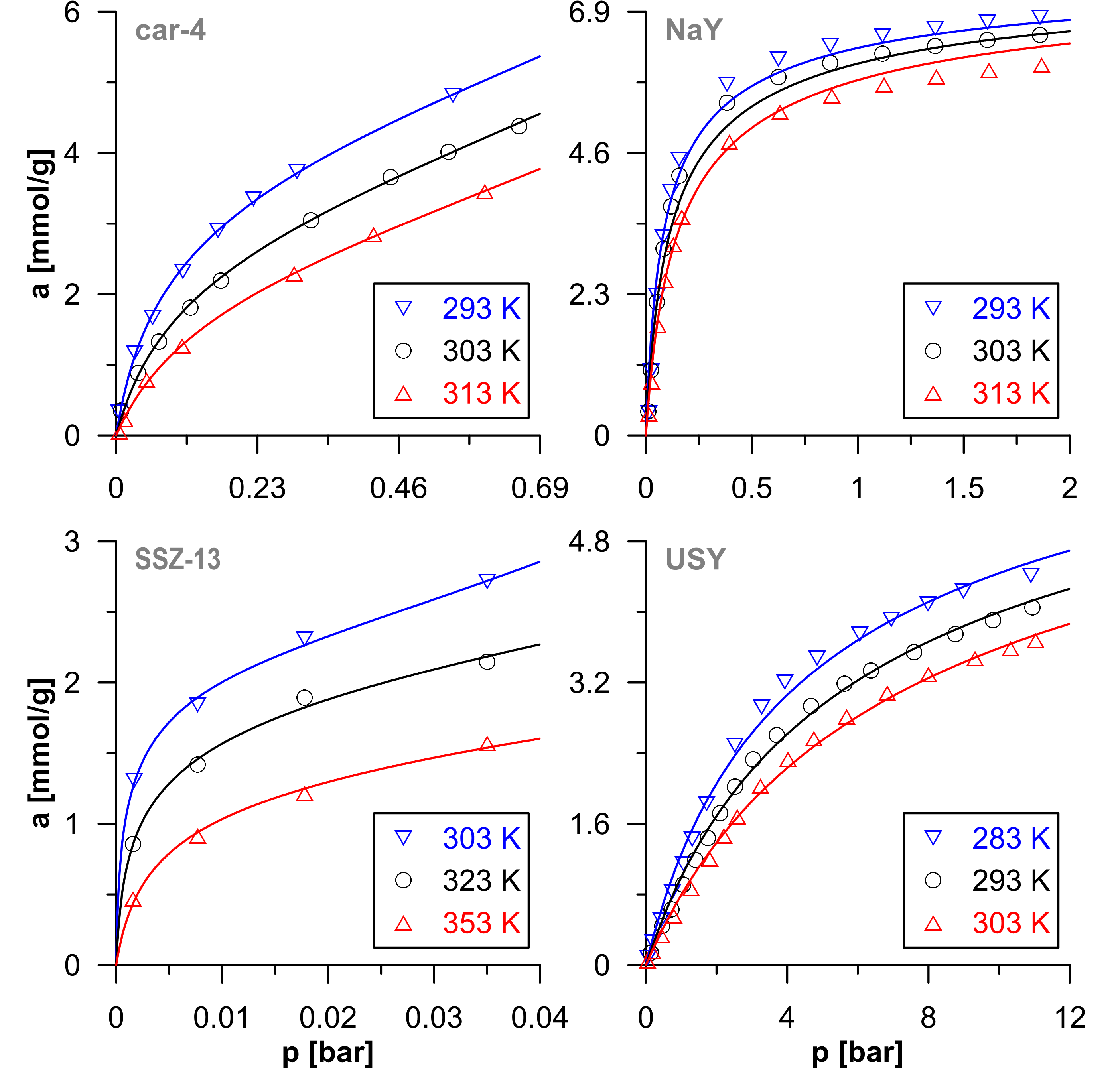
Adsorption of hydrogen sulphide is a process of practical importance, among others, in the context of biogas desulphurization. Its full understanding may require knowledge about the related thermodynamic aspects. In the current study, the possibility of indirectly obtaining such data based on mathematical modelling of the temperature dependence of H₂S adsorption isotherms is examined. For this purpose, a cooperative multimolecular sorption model was selected as the theoretical isotherm equation. It was used to simultaneously fit several sets of experimental data on a multi-temperature way. Such an approach, despite certain limitations, is an effective tool for modelling hydrogen sulphide adsorption on the studied activated carbons and zeolites. Furthermore, it allows for the straightforward calculation of thermodynamic quantities characterizing the process: the isosteric enthalpy of adsorption and the entropy of the adsorbed phase. In the study, curves reflecting the changes in these functions with adsorption progress were successfully determined and analyzed, supplementing the quantitative characterization of the process.
Downloads
References
Gao X, Xiao Z, Wu P, Liu Y, Xu H, Wang Y. Recent research advances in adsorption removal of gaseous hydrogen sulfide by biochar. Fuel. 2025;388:134390. https://doi.org/10.1016/j.fuel.2025.134390.
Liu X, Wang M, Zhang X, Liang T. A new insight: investigating calcium silicate hydrate as a potential adsorbent for hydrogen sulfide removal. Surfaces and Interfaces 2025;56:105669. https://doi.org/10.1016/j.surfin.2024.105669.
Chanka N, Somchuea P, Chareonpanich M, Wattanakit C, Faungnawakij K, Rupprechter G, Seubsai A. High-efficiency hydrogen sulfide removal using copper (II) nitrate-impregnated ZSM-5 derived from sugarcane bagasse ash. Colloids and Surfaces A. 2025;716:136749. https://doi.org/10.1016/j.colsurfa.2025.136749.
Martin AD, Ravenni G, Thomsen TP. Low-cost hydrogen sulfide removal with biochar and activated biochar. Next Research. 2025;2:100286. https://doi.org/10.1016/j.nexres.2025.100286.
Wierzba M, Paluch D, Bazan-Woźniak A, Pietrzak R. Węglowe materiały adsorpcyjne z pozostałości po ekstrakcji nadkrytycznej róży pomarszczonej do oczyszczania gazów i cieczy. Wiadomości Chemiczne. 2025;79:199–214. https://doi.org/10.53584/wiadchem.2025.3.2.
Hoang TLG, Doan DT, Nanda S, Lavoie R, Nguyen-Tri P. Development of metal-organic framework-based systems for H₂S removal: A comprehensive review. Coordination Chemistry Reviews. 2025;529:216466. https://doi.org/10.1016/j.ccr.2025.216466.
Melas GA, Habtu NG, Worku AK, Getahun E. Recent progresses and future perspective of biogas-upgrading techniques. Bioenergy Research. 2025;18:80. https://doi.org/10.1007/s12155-025-10875-3.
Meena PK, Pal A. A comprehensive review on methane enrichment in biogas through the purification process using biomass-based adsorbents. Biomass Conversion and Biorefinery. 2025;15:8287–8309. https://doi.org/10.1007/s13399-024-05605-2.
Perera WAHV, Hosan KS, Wijesekara RJMDDP, Priyadarshana HVV, Abeysinghe SS, Amarasinghe AMPC, Koswattage KR. Biogas Purification Technologies: A comparative review of methods and accessibility for sustainable energy applications. Journal of Agriculture and Value Addition. 2025;8:44–73. https://doi.org/10.4038/java.v8i1.148.
Jepleting A, Mecha AC, Sombei D, Moraa D, Chollom MN. Potential of low-cost materials for biogas purification, a review of recent developments. Renewable and Sustainable Energy Reviews. 2025;210:115152. https://doi.org/10.1016/j.rser.2024.115152.
Uranga-Valencia LP, Pérez-Álvarez S, Gabriel-Parra R, Chávez-Medina JA, Magallanes-Tapia MA, Sánchez-Chávez E, Muñoz-Márquez E, García-García SA, Rascón-Solano J, Castruita-Esparza LU. Biogas production from organic waste in the forestry and agricultural context: Challenges and solutions for a sustainable future. Energies. 2025;18:3174. https://doi.org/10.3390/en18123174.
Pilarski K, Pilarska AA, Dach J. Biogas as renewable energy source: A brief overview. Journal of Ecological Engineering. 2025;26:408–416. https://doi.org/10.12911/22998993/203376.
Sharma R, Choudhary P, Thakur G, Pathak A, Singh S, Kumar A, Lo S-L, Kumar P. Sustainable management of biowaste to bioenergy: A critical review on biogas production and techno-economic challenges. Biomass and Bioenergy. 2025;196:107734. https://doi.org/10.1016/j.biombioe.2025.107734.
Loboichenko V, Iranzo A, Casado-Manzano M, Navas SJ, Pino FJ, Rosa F. Study of the use of biogas as an energy vector for microgrids. Renewable and Sustainable Energy Reviews. 2024;200:114574. https://doi.org/10.1016/j.rser.2024.114574.
Keller JU, Staudt R. Gas Adsorption Equilibria. Experimental Methods and Adsorptive Isotherms. New York: Springer; 2005. https://doi.org/10.1007/b102056.
Cruz AJ, Pires J, Carvalho AP, De Carvalho MB. Physical adsorption of H₂S related to the conservation of works of art: The role of the pore structure at low relative pressure. Adsorption. 2005;11:569–576. https://doi.org/10.1007/s10450-005-5614-3.
Tagliabue M, Bellussi G, Broccia P, Carati A, Millini R, Pollesel P, Rizzo C. High pressure hydrogen sulphide adsorption on silica-aluminas. Chemical Engineering Journal. 2012;210:398–403. https://doi.org/10.1016/j.cej.2012.08.076.
Gebreegziabher TB, Wang S, Nam H. Adsorption of H₂S, NH₃ and TMA from indoor air using porous corncob activated carbon: Isotherm and kinetics study. Journal of Environmental Chemical Engineering. 2019;7:103234. https://doi.org/10.1016/j.jece.2019.103234.
Tokunaga N, Oshiyama H, Nitta T, Katayama T. Adsorption isotherms of methane, hydrogen sulfide, and mixed gas of methane and carbon dioxide on activated carbon fiber. Journal of Chemical Engineering of Japan. 1988;21:431–433. https://doi.org/10.1252/jcej.21.431.
Kokhkharov M, Sultonov A, Jumaeva D, Kholmedov K, Ganiev A, Ochilova O. Isotherm and differential enthalpy of hydrogen sulfide adsorption on an activated sorbent derived from hybrid tomentosa wood. Universum: Chemistry and Biology. 2025;9:28–33. https://doi.org/10.32743/UniChem.2025.135.9.20762.
Meljac L, Perier-Camby L, Thomas G. Calorimetric study of reactions occurring between impregnated activated fibres and hydrogen sulphide. Carbon. 2005;43:1407–1415. https://doi.org/10.1016/j.carbon.2005.01.011.
Abdurakhmonov E, Dekhkanova N. Thermodynamics of hydrogen sulfide adsorption in zeolite LiX. E3S Web of Conferences. 2023;413:04004. https://doi.org/10.1051/e3sconf/202341304004.
Dekhkanova N, Abdurakhmonov E, Rakhmatkarieva F, Houlbert I, Jamoliddinova N. Thermodynamics of hydrogen sulfide adsorption in NaX zeolite. E3S Web of Conferences 2023;402:14037. https://doi.org/10.1051/e3sconf/202340214037.
Chavan S, Bonino F, Valenzano L, Civalleri B, Lamberti C, Acerbi N, Cavka JH, Leistner M, Bordiga S. Fundamental aspects of H₂S adsorption on CPO-27-Ni. Journal of Physical Chemistry C. 2013;117:15615–15622. https://doi.org/10.1021/jp402440u.
Nuhnen A, Janiak C. A practical guide to calculate the isosteric heat/enthalpy of adsorption via adsorption isotherms in metal-organic frameworks, MOFs. Dalton Transactions. 2020;49:10295–10307. https://doi.org/10.1039/D0DT01784A.
Shen D, Bülow M, Siperstein F, Engelhard M, Myers AL. Comparison of experimental techniques for measuring isosteric heat of adsorption. Adsorption. 2000;6:275–286. https://doi.org/10.1023/A:1026551213604.
Girish CR. Determination of thermodynamic parameters in adsorption studies: A review. Chemical Papers. 2025;79:5687–5706. https://doi.org/10.1007/s11696-025-04218-x.
Sircar S, Mohr R, Ristic C, Rao MB. Isosteric heat of adsorption: theory and experiment. Journal of Physical Chemistry B. 1999;103:6539–6546. https://doi.org/10.1021/jp9903817.
Tian Y, Wu J. Differential heat of adsorption and isosteres. Langmuir. 2017;33:996–1003. https://doi.org/10.1021/acs.langmuir.7b00004.
Furmaniak S. Multitemperature fitting of isotherms as a simple method of insight into the thermodynamics of water sorption on building materials. Bulgarian Chemical Communications. 2014;46:563–568.
Malakhov AO, Volkov VV. Cooperative multimolecular sorption equation: Application to an alcohol–poly(1-trimethylsiyl-1-propyne) system. Polymer Science Series A. 2000;42:120–1126.
Rutherford SW. Application of cooperative multimolecular sorption theory for characterization of water adsorption equilibrium in carbon. Carbon. 2003;41:622–625. https://doi.org/10.1016/S0008-6223(02)00420-7.
Plaza MG, Durán I, Querejeta N, Rubiera F, Pevida C. Experimental and simulation study of adsorption in postcombustion conditions using a microporous biochar. 2: H₂O, CO₂, and N₂ adsorption. Industrial & Engineering Chemistry Research. 2016;55:6854–6865. https://doi.org/10.1021/acs.iecr.6b01720.
Furmaniak S, Terzyk AP, Szymański GS, Gauden PA, Motak M, Kowalczyk P, Rychlicki G. Thermodynamics of the CMMS approach and carbon surface chemistry in SO₂ adsorption. Langmuir. 2006;22:6887–6892. https://doi.org/10.1021/la060374r.
Furmaniak S, Terzyk AP, Czepirski L, Komorowska-Czepirska E, Szymońska J, Gauden PA. Water sorption on foodstuffs – alternative models. In: Pletney VN, editor. Focus on Food Engineering Research and Developments. New York: Nova Science Publishers; 2007. p. 497–515.
Boki K, Tanada S. Adsorption of hydrogene sulfide on activated carbon. Chemical and Pharmaceutical Bulletin. 1980;28:1270–1275. https://doi.org/10.1248/cpb.28.1270.
de Oliveira LH, Meneguin JG, Pereira MV, da Silva EA, Grava WM, do Nascimento JF, Arroyo PA. H₂S adsorption on NaY zeolite. Microporous and Mesoporous Materials. 2019;284:247–257. https://doi.org/10.1016/j.micromeso.2019.04.014.
Thompson JA. Acid gas adsorption on zeolite SSZ-13: Equilibrium and dynamic behavior for natural gas applications. AIChE Journal. 2020;66:e16549. https://doi.org/10.1002/aic.16549.
Rahmani M, Mokhtarani B, Rahmanian N. High pressure adsorption of hydrogen sulfide and regeneration ability of ultra-stable Y zeolite for natural gas sweetening. Fuel. 2023;343:127937. https://doi.org/10.1016/j.fuel.2023.127937.
Storn R, Price K. Differential evolution – a simple and efficient heuristic for global optimization over continuous spaces. Journal of Global Optimization. 1997;11:341–359. https://doi.org/10.1023/A:1008202821328.
Gauden PA, Furmaniak S, Włoch J, Terzyk AP, Zieliński W, Kowalczyk P, Kurzawa J. The influence of geometric heterogeneity of closed carbon nanotube bundles on benzene adsorption from the gaseous phase – Monte Carlo simulations. Adsorption. 2016;22:639–651. https://doi.org/10.1007/s10450-015-9746-9.
Rutherford SW, Coons JE. Equilibrium and kinetics of water adsorption in carbon molecular sieve: Theory and experiment. Langmuir. 2004;20:8681–8687. https://doi.org/10.1021/la049330d.
Downloads
Published
Issue
Section
License
Copyright (c) 2026 Sylwester Furmaniak, Piotr A. Gauden

This work is licensed under a Creative Commons Attribution-ShareAlike 4.0 International License.