
Extreme sleep fragmentation for 11 consecutive days and nights does not significantly alter total sleep time, and sleep stage distribution, during the continuous alpine downhill skiing world record
DOI:
https://doi.org/10.5604/01.3001.0015.6743Słowa kluczowe:
ćwiczenia, regeneracja, odporność, sport, fazy snu, deprywacja snu, fragmentacja snu, ekspedycjaAbstrakt
Introduction: Extreme levels of sleep deprivation, fragmentation and management, are major problems in many sportive disciplines, ultramarathons, polar or extreme altitude expeditions, and in space operations.
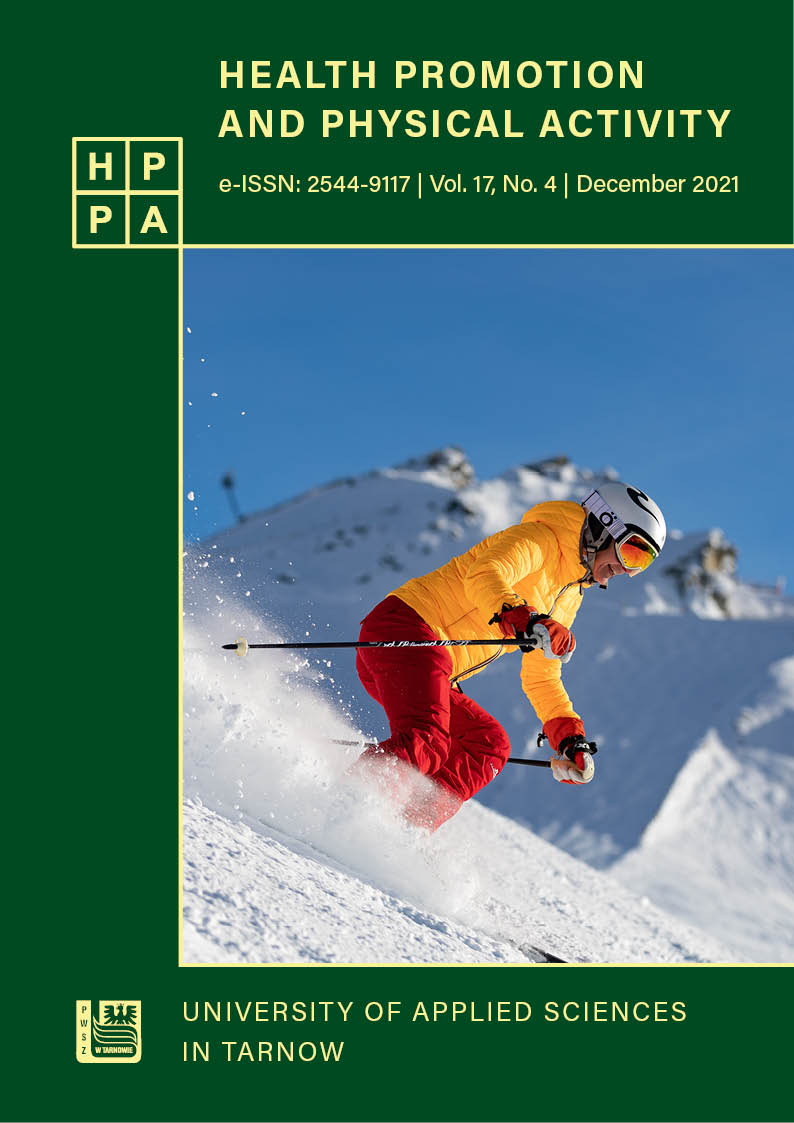
Material and methods: Polysomnographic (PSG) data was continuously recorded (total sleep time and sleep stage distribution) in a 34-year-old male whilst performing the new world record in long-term downhill skiing. He napped only during the short ski lift rides for 11 days and nights.
Results: After an initial period of complete sleep deprivation for 24 hours, total sleep time and the total times of non-REM and REM achieved during the lift rides returned to standard values on the second day. PSG data revealed an average sleep time per 24 hours of 6 hours and 6 minutes. During daylight sleep was rarely registered. The subject experienced only two minor falls without injury and immediately resumed skiing.
Conclusion: In a healthy, trained, elite male athlete, sleep fragmentation over 11 consecutive days did not significantly impair the sleep, motor or cognitive skills required to perform a continuous downhill skiing world record after an initial adaptation phase
Pobrania
Bibliografia
Filardi M, Morini S, Plazzi G. Pre-race sleep management strategy and chronotype of offshore solo sailors. Nat Sci Sleep. 2020;12:263-269. doi: 10.2147/NSS.S241162.
Thomas MJW, Paterson JL, Jay M, Matthews RW, Ferguson SA. More than hours of work: Fatigue management during high-intensity maritime operations. Chronobiol Int. 2019;36(1):143-149. doi: 10.1080/07420528.2018.1519571.
Jaipurkar R, Mahapatra SS, Bobdey S, Banerji C. Work-rest pattern, alertness and performance assessment among naval personnel deployed at sea: A cross sectional study. Med J Armed Forces India. 2019;75(2):158-163. doi: 10.1016/j.mjafi.2018.01.005.
Pattyn N, Mairesse O, Cortoos A, Marcoen N, Neyt X, Meeusen R. Sleep during an Antarctic summer expedition: New light on “polar insomnia”. J Appl Physiol (1985). 2017;122(4):788-794. doi: 10.1152/japplphysiol.00606.2016.
Galvani C, Ardigò LP, Alberti M, Daniele F, Capelli C. Physical activity, sleep pattern and energy expenditure in double-handed offshore sailing. J Sports Med Phys Fitness. 2015;55(12):1480-1488.
Hurdiel R, van Dongen HPA, Aron C, McCauley P, Jacolot L, Theunynck D. Sleep restriction and degraded reaction-time performance in Figaro solo sailing races. J Sports Sci. 2014;32(2):172-174. doi: 10.1080/02640414.2013.815359.
Buguet A, Cespuglio R, Radomski MW. Sleep and stress in man: An approach through exercise and exposure to extreme environments. Can J Physiol Pharmacol. 1998;76(5):553-561. doi: 10.1139/cjpp-76-5-553.
Walsh NP, et al. Sleep and the athlete: Narrative review and 2021 expert concensus recommendations. Br J Sports Med. 2021;55:356-368.
Walsh NP, et al. Sleep and the athlete: narrative review and 2021 expert consensus recommendations. Br J Sports Med. 2020. doi: 10.1136/bjsports-2020-102025.
Durmer JS. Dinges DF. Neurocognitive consequences of sleep deprivation. Semin Neurol. 2005;25(1):117-129. doi: 10.1055/s-2005-867080.
Gupta L, Morgan K, Gilchrist S. Does elite sport degrade sleep quality? A systematic review. Sports Med. 2017;47(7):1317-1333. doi: 10.1007/s40279-016-0650-6.
Palinkas LA. Suedfeld P. Psychological effects of polar expeditions. Lancet. 2008;371(9607):153-163. doi: 10.1016/S0140-6736(07)61056-3.
Andersen JH, Boesen HC, Skovgaard Olsen K. Sleep in the Intensive Care Unit measured by polysomnography. Minerva Anestesiol. 2013;79(7):804-815.
Anholm JD, et al. Operation Everest II: Arterial oxygen saturation and sleep at extreme simulated altitude. Am Rev Respir Dis. 1992;145(4 Pt 1):817-826. doi: 10.1164/ajrccm/145.4_Pt_1.817.
Netzer NC. Strohl KP. Sleep and breathing in recreational climbers at an altitude of 4200 and 6400 meters: Observational study of sleep and patterning of respiration during sleep in a group of recreational climbers. Sleep Breath. 19993;(3):75-82. doi: 10.1007/s11325-999-0075-7.
Doppelmayr MM, Finkernagel H, Doppelmayr HI. Changes in cognitive performance during a 216 kilometer, extreme endurance footrace: A descriptive and prospective study. Percept Mot Skills. 2005;100(2):473-487. doi: 10.2466/pms.100.2.473-487.
Edinger JD, Marsh GR, McCall WV, Erwin CW, Lininger AW. Daytime functioning and nighttime sleep before, during, and after a 146-hour tennis match. Sleep. 1990;13(6):526-532. doi: 10.1093/sleep/13.6.526.
Léger D, Elbaz M, Raffray T, Metlaine A, Bayon V, Duforez F. Sleep management and the performance of eight sailors in the Tour de France à la voile yacht race. J Sports Sci. 2008;26(1):21-28. doi: 10.1080/02640410701348636.
Moser D, et al. Sleep classification according to AASM and Rechtschaffen & Kales: Effects on sleep scoring parameters. Sleep. 2009;32(2):139-149. doi: 10.1093/sleep/32.2.139.
Berry RB, et al. Rules for scoring respiratory events in sleep: update of the 2007 AASM Manual for the Scoring of Sleep and Associated Events. Deliberations of the Sleep Apnea Definitions Task Force of the American Academy of Sleep Medicine. J Clin Sleep Med. 2012;8(5):597-619. doi: 10.5664/jcsm.2172.
Ruehland WR, et al. The 2007 AASM recommendations for EEG electrode placement in polysomnography: Impact on sleep and cortical arousal scoring. Sleep. 2011;34(1):73-81. doi: 10.1093/sleep/34.1.73.
Heinrich J, Spießhöfer J, Bitter T, Horstkotte D, Oldenburg O. Implications of revised AASM rules on scoring apneic and hypopneic respiratory events in patients with heart failure with nocturnal Cheyne-Stokes respiration. Sleep Breath. 2015;19(2):489-494. doi: 10.1007/s11325-014-1014-9.
Laharnar N, et al. A sleep intervention study comparing effects of sleep restriction and fragmentation on sleep and vigilance and the need for recovery. Physiol Behav. 2020;215:112794. doi: 10.1016/j.physbeh.2019.112794.
Wu H, et al. Effects of different sleep restriction protocols on sleep architecture and daytime vigilance in healthy men. Physiol Res. 2010;59(5):821-829. doi: 10.33549/physiolres.931895.
Ohayon MM, Carskadon MA, Guilleminault C, Vitiello MV. Meta-analysis of quantitative sleep parameters from childhood to old age in healthy individuals: developing normative sleep values across the human lifespan. Sleep. 2004;27(7):1255-1273. doi: 10.1093/sleep/27.7.1255.
Blanchfield AW, Lewis-Jones TM, Wignall JR, Roberts JB, Oliver SJ. The influence of an afternoon nap on the endurance performance of trained runners. Eur J Sport Sci. 2018;18(9):1177-1184. doi: 10.1080/17461391.2018.1477180.
Milner CE. Cote KA. Benefits of napping in healthy adults: Impact of nap length, time of day, age, and experience with napping. J Sleep Res. 2009;18(2):272-281. doi: 10.1111/j.1365-2869.2008.00718.x.
O’Donnell S, Beaven CM, Driller M. The influence of match-day napping in elite female netball athletes. Int J Sports Physiol Perform. 2018;13(9):1143-1148. doi: 10.1123/ijspp.2017-0793.
Küpper T, et al. Occupational aspects of work in hypoxic conditions – the new recommendation of the Medical Commission of the Union Internationale des Associations d’alpinisme (UIAA MedCom). Med Sport. 2010;14(1):34-39.
Küpper T, Gieseler U, Angelini C, Hillebrandt D, Milledge J. Consensus Statement of the UIAA Medical Commission. Vol. 2: Emergency Field Management of Acute Mountain Sickness, High Altitude Pulmonary Oedema, and High Altitude Cerebral Oedema. 2012 [cited 2021]. Available from: https://www.theuiaa.org/documents/mountainmedicine/English_UIAA_MedCom_Rec_No_2_AMS_HAPE_HACE_2012_V3-2.pdf.
Pobrania
Opublikowane
Numer
Dział
Licencja
Prawa autorskie (c) 2021 Autorzy

Utwór dostępny jest na licencji Creative Commons Uznanie autorstwa – Na tych samych warunkach 4.0 Miedzynarodowe.